Level 1 Charging Explained
The cord that came free with the car, plugged into an outlet you already own. It is slower than everything else in EV charging and, for a meaningful minority of drivers, entirely sufficient — which nobody selling chargers wants to say.
How this is funded: we earn a commission if you buy through our links, at no extra cost to you. It never changes which product we recommend, and we’ll tell you when we’d skip one. Full disclosure.
Every EV in North America ships with a way to charge from an ordinary wall socket. Open the trunk, find a bag with a chunky black cordset in it: one end is a normal three-prong plug, the other is the connector that goes into the car. That is Level 1 charging, and it is the only kind that requires you to buy or install nothing at all.
DOE describes Level 1 as delivering roughly 1.4 kW, adding about 3 to 5 miles of range per hour. Level 2, for contrast, spans about 2.9 to 19.2 kW with around 7.2 kW typical in a residential install — roughly 25 miles of range an hour. That is the entire difference, and everything else on this page is a consequence of it.
Where the 1.4 kW comes from
Power is volts × amps. A North American household outlet is 120 volts, and a typical charging cordset draws 12 ampsfrom it — deliberately, because the NEC treats EV charging as a continuous load and limits a continuous draw to 80% of the circuit rating. Twelve amps is 80% of a 15-amp circuit. Multiply: 120 × 12 = 1,440 watts, or 1.44 kW.
Some cordsets can be set to 16 amps where a dedicated 20-amp circuit exists, giving about 1.9 kW. That is a genuine 30% improvement, it requires an electrician, and at that point most people are one conversation away from a 240-volt circuit that does four times better. Which is the honest argument for skipping the middle step.
Level 2, by comparison, doubles the voltage to 240 volts and raises the current, which is why it is not twice as fast but four to ten times as fast. We take that apart in Level 1 vs Level 2.
What Level 1 actually replaces overnight
Nobody charges from empty to full on Level 1, so the useful question is not “how long to charge the car” but “can it keep up with my driving?” Take your daily miles and see how many hours of charging they cost you.
| Your driving | Hours to replace it | Verdict |
|---|---|---|
| 20 miles a day | About 5 hours | Comfortable — plugged in less than half the night |
| 30 miles a day | About 7.5 hours | Fine on a normal overnight window |
| 40 miles a day | About 10 hours | Tight but workable if the car sits all night |
| 50 miles a day | About 12.5 hours | You are now losing ground on some nights |
| 70 miles a day | About 17.5 hours | Not possible — the deficit compounds |
The pattern is clear: Level 1 works when your daily driving is roughly under 40 miles and the car genuinely sits at home overnight. That is not a small group. It covers a large share of second cars, a large share of retirees, and almost every plug-in hybrid.
Above that, the arithmetic turns against you in a specific and unpleasant way: a deficit does not stay flat, it compounds. Two heavy days back to back and you start the week further behind than you finished it, which is when people discover public charging prices. Our home vs public cost comparison shows what that habit costs.
Who Level 1 genuinely suits
Plug-in hybrid owners.The strongest case by far. A PHEV’s battery is small enough that Level 1 can refill it overnight, and DOE notes most plug-in hybrids cannot DC fast charge at all — so their entire charging life happens at Level 1 or Level 2 anyway. Many PHEV owners never need anything else, and our PHEV roundup is honest about which of them should still upgrade.
Low-mileage households.If a week’s odometer reading divided by seven comes out under 30, Level 1 is not a compromise, it is a correct engineering answer. Do that measurement before buying anything — on the real week, not the imagined one.
Renters and anyone who cannot modify the building. Sometimes there is no alternative, and Level 1 from an existing outlet is what makes EV ownership possible at all. Our renter roundup covers the plug-in Level 2 options where a 240-volt outlet does exist.
As a backup, permanently.Keep the cordset in the car regardless. It has rescued a great many people at a relative’s house.
Four things that go wrong with Level 1
Extension cords.The most common and most dangerous mistake. A charging session is hours of near-maximum continuous draw, and every junction — cord to plug, plug to outlet — is a place for heat to build. Manufacturers say not to for exactly this reason. If the outlet is out of reach, move the outlet.
Shared circuits.Twelve amps is most of a 15-amp circuit’s continuous capacity. Add a freezer or a space heater on the same run and the breaker does its job at an inconvenient hour. A dedicated receptacle solves it cheaply.
Tired outlets. A worn receptacle that holds a plug loosely is a resistance heater waiting for an excuse. If the plug feels warm after a session, or the outlet is old and slack, have it replaced before you keep using it nightly.
Winter.The one people do not anticipate. At 1.4 kW, a meaningful fraction of the power can go into conditioning the battery and the cabin rather than adding range, so a cold night can add far less than the table above suggests. In a cold climate this is often what finally decides the Level 2 question — the numbers are in winter charging cost.
When to stop and go to Level 2
The trigger is not a feeling, it is arithmetic. Level 1 has stopped working when your daily driving reliably exceeds what an overnight window replaces — roughly 40 to 50 miles for most cars — or when you find yourself planning around the charger rather than ignoring it.
The upgrade need not be dramatic. A 16 or 24-amp Level 2 charger on a small circuit is already three to five times Level 1, which is enough for almost anyone, and it is a much smaller electrical project than a 60-amp run. Work out what you actually need with what size charger do I need, and check what your panel can spare with our panel capacity guide before you shop.
If a 240-volt outlet already exists in the garage — a dryer or welder circuit, say — the jump is cheaper than most people assume, because a plug-in charger needs no electrician at all in that case. These three are the ones we would look at first.
Quick picks
Ranked on published specs, charging speed, electrical fit and value. Select a row to jump to the full write-up. We have not bench-tested these chargers — here is exactly what we do instead.
| # | Product | Best for | Price |
|---|---|---|---|
| 1 | 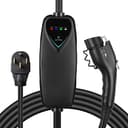 Lectron 40A Portable Level 2 Charger One of the cheapest honest ways into real Level 2 charging. Plug it into a NEMA 14-50 outlet, get a genuine 40A / 9.6 kW, and unplug it to take on a trip. No app and a shorter warranty are the trade-offs for the price. | Cheapest honest step up from Level 1 | $269.99 · View on Amazon Price as of October 18, 2026. #ad How we’re funded |
| 2 | 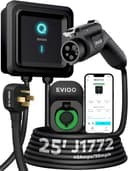 EVIQO 40A NEMA 14-50 Charger The most charger you can get without an electrician's invoice. It plugs into a NEMA 14-50 outlet for a full 40 amps, keeps the WiFi app, the ENERGY STAR listing and the 25 ft cable from EVIQO's hardwired unit, and can be unplugged and taken with you when you move. | Plug-in 40A with scheduling and energy data | |
| 3 | 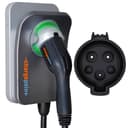 ChargePoint Home Flex The safest default for most homes: you set the amperage in the app to 16, 24, 32, 40, 48 or 50A, so one charger fits whatever circuit your panel can spare today and scales up if you upgrade later. The app is the most mature here, firmware arrives over the air, and the warranty is long. | Dial it to 16A now, raise it later | $516.71 · View on Amazon Price as of October 18, 2026. #ad How we’re funded |
And if you are not convinced the upgrade pays for itself, do not take our word for it — is a Level 2 charger worth it runs the payback honestly, including the cases where the answer is no.
Frequently asked questions
What is Level 1 charging?
Charging an EV from a standard 120-volt household outlet using the cordset supplied with the car. DOE describes it as delivering roughly 1.4 kW and adding about 3 to 5 miles of range per hour. It is the slowest of the three charging levels and the only one that needs no new equipment or wiring.
How many kW is Level 1 charging?
About 1.4 kW in typical use. The arithmetic is 120 volts times the current the cordset draws — commonly 12 amps, which is 1.44 kW. Some cordsets draw 16 amps on a dedicated 20-amp circuit for about 1.9 kW, but 12 amps on a shared 15-amp circuit is the ordinary case.
How long does Level 1 take to fully charge an EV?
For a 60 kWh battery from empty, roughly 40 hours or more — which is why nobody plans around a full Level 1 charge. The realistic measure is what it replaces overnight: at 4 miles per hour over a 12-hour window, about 48 miles. If your daily driving is comfortably under that, the pack never runs down.
Is Level 1 charging bad for the battery?
No. Slow charging is gentler on cells than fast charging, not harsher. The genuine drawbacks of Level 1 are practical — the speed, the temptation to use an extension cord, and the fact that in cold weather a slow charge can be largely consumed by keeping the battery and cabin conditioned rather than adding range.
Can I use an extension cord for Level 1 charging?
Vehicle manufacturers almost universally say not to, and the reason is heat. A charging session is a continuous load for many hours, and an undersized or worn cord — or the connection between cord and plug — is where that heat concentrates. If the outlet is out of reach, the correct fix is having an electrician move or add an outlet, not adding cable.
Should the Level 1 outlet be on its own circuit?
Ideally, yes. A charging cordset draws close to the continuous limit of a 15-amp circuit for hours at a time, so sharing that circuit with a freezer, a workshop tool or a space heater is how breakers trip at 3am. A dedicated 15 or 20-amp receptacle is a small job for an electrician and removes the whole problem.
Sources
- U.S. DOE Alternative Fuels Data Center — Electric Vehicle Charging Stations — US DOE on charging levels: Level 1 (~1.9 kW, ~5 mi/hr), Level 2 (2.9-19.2 kW, ~7.2 kW typical residential, ~25 mi/hr), and DC fast charging (accessed July 19, 2026)
- U.S. DOE Alternative Fuels Data Center — Charging Electric Vehicles at Home — US DOE on home EV charging: most owners charge overnight on Level 1 or Level 2, installs follow NEC Article 625, with example home-charging costs (accessed July 19, 2026)
- FuelEconomy.gov — Electric Vehicles: Learn More About the Label — DOE/EPA on EV efficiency: kWh per 100 miles and MPGe, accounting for AC charging losses (accessed July 19, 2026)
- NFPA — Using the Latest NEC for EV Charger Installations — NFPA on NEC (NFPA 70) Article 625: EV charging is a continuous load, so circuits are sized to 125% of load (the 80% rule) (accessed July 19, 2026)
- SAE International — J1772 Conductive Charge Coupler — The SAE J1772 connector standard for AC Level 1 and Level 2 charging in North America (accessed July 19, 2026)
- U.S. DOE Alternative Fuels Data Center — Electric Vehicles for Consumers (PHEV charging) — US DOE on plug-in hybrids and charging speed, re-read for this page: Level 1 adds 2 to 5 miles of range per hour, Level 2 adds 10 to 30 miles per hour and DC fast charging adds 100 to 200+ miles in 30 minutes; 'most PHEVs are not able to charge via DCFC', so Level 1 and Level 2 are the practical options for them; Level 1 and Level 2 both use the SAE J1772 connector (accessed August 12, 2026)
Keep reading
Level 1 vs Level 2
The direct comparison, with the miles-per-hour math that makes the case for 240 volts.
Compare the twoIs the upgrade worth it?
What the hardware and the electrician actually cost, and when Level 1 is the rational choice.
Run the paybackChargers for plug-in hybrids
The group Level 1 suits best — small packs, modest onboard chargers, no DC fast charging.
See PHEV picksWhy your car sets the speed
The onboard charger is the real ceiling — at Level 1, at Level 2, and everywhere in between.
Understand the limit