Is It OK to Leave an EV Plugged In?
Yes - and the reason this question causes so much anxiety is a simple confusion between two states. A plugged-in car is not a charging car. Once the session ends, the charger stops delivering current and sits waiting. Here is what is actually happening, what it costs, and when staying plugged in is the better choice.
How this is funded: we earn a commission if you buy through our links, at no extra cost to you. It never changes which product we recommend, and we’ll tell you when we’d skip one. Full disclosure.
Yes, it is fine to leave an EV plugged in, including overnight and including for long stretches. The anxiety behind this question almost always comes from one piece of mental furniture that does not apply: the memory of a phone or a power tool left on a cheap charger, getting hot, with the charger dumbly pushing current into a full cell. An EV does not work that way, and the reason is worth understanding, because it also explains what your charger is doing while it waits.
Plugged in is not the same as charging
A Level 2 charger is a gatekeeper, not a pump. It cannot push energy into your car; it offers a current limit, and the car’s own onboard charger decides what to draw. That negotiation happens over a dedicated pilot wire before any current flows at all — the charger confirms the connector is seated and the ground path is sound, agrees a limit with the car, and only then closes the contactor. We walk through that sequence in what happens when you plug in, and in onboard chargers explained.
The consequence is the whole answer to this page. When the car reaches whatever charge limit you set, the car stops drawing. The cable goes quiet. The charger has not been overruled or overridden; it was never in charge of the decision. From that point the system is a plugged-in cable and a charger sitting in standby, and it will stay that way until the car asks for something.
That is also why the state of charge question is a car question rather than a charger question. If you want to stop at 80%, you set that in the car’s own menu, and every modern EV has the setting. Your vehicle manufacturer’s guidance is the only authority on your battery — we are a charger site and we will not invent a battery-care rule for a car we have not got documentation for.
What the charger draws while it waits
Something, continuously. A connected charger keeps its electronics, its ground-monitoring and, if it has them, its radios alive so it can respond when you plug in. That is standby draw, and it is the specific thing the ENERGY STAR programme for EV chargers measures: ENERGY STAR states that certified chargers use about 40% less energy in standby than non-certified units.
Put that next to the duty cycle of a home charger and the certification stops looking like a sticker. A charger that fills your car in seven hours is idle for the other seventeen, every day, for a decade. The 40% applies to the state the unit is in for the overwhelming majority of its life. It is a small absolute number either way — with EIA putting US residential electricity at 17.30 cents per kWh in 2025 the annual cost of standby is not what will move your bill — but it is free to choose the certified unit, which is why we keep an ENERGY STAR roundup, and why certification also matters for utility rebate eligibility.
If you want the real driver of your charging bill, it is not standby and it is not whether you unplug — it is the rate you charge on. Our electric-bill breakdown and time-of-use guide are where the money actually is.
When staying plugged in is the better choice
In cold weather, leaving the car connected is not merely harmless — it is actively the efficient option, and the DOE and EPA publish the reason. Their cold-weather guidance records that EV range can drop about 41% in mixed driving at 20F versus 75F with the cabin heater running, against about 12% with the heater off; roughly two thirds of that extra energy goes into heating the cabin rather than moving the car. And their recommendation follows directly: preheating while still plugged in extends range.
That is a straight transfer of load. Warm the cabin on shore power and the battery starts the trip full and warm instead of spending a chunk of itself on the heater in the first ten minutes. Unplug the car the night before a cold morning and you pay for that heat out of your range. Our winter charging page costs this out, and our cold-weather roundup covers the hardware side.
The second case is scheduling. If you are on a time-of-use rate, the charger or the car needs to be connected before the cheap window opens so the session can start without you. Plugging in at 6pm and letting a schedule fire at 1am is the normal way to use a TOU tariff, and it requires exactly the behaviour this page is about. Emporia lists Smart Scheduling on its chargers and Grizzl-E ships scheduling in the Connect app; most cars will also do it themselves from the dash, which is why we argue in smart versus dumbthat the charger’s scheduler is often a duplicate of one you already own.
The habit that does cost you
If there is a real mistake in this area, it is not leaving the car plugged in. It is leaving the connectorwherever it fell. A handle on the garage floor or the driveway gets driven over, filled with grit, frozen into ice and soaked in standing water, and the cable and connector are the part of the system the industry itself expects to fail first — Autel’s own US store listing warrants its 80-amp charger body for five years and the charging cable and connector for one.
Every unit we list ships somewhere to hang it: Lectron supplies a J-hook and plug holder, ELEGRP a wall holder, Autel an in-body holster on the 40A, Grizzl-E a holster. Use it. See how long chargers last for the full warranty picture and what an outdoor rating covers for the weather side.
Chargers that make staying plugged in worth it
If the car is going to live connected, the two features that earn their keep are an ENERGY STAR listing — because standby is the state it is in nearly all the time — and a scheduler that can start a session in the cheap window without you. These four carry both.
| Spec | EVIQO 48A Level 2 Charger | ChargePoint Home Flex | Emporia Pro | Grizzl-E Classic Connect 40A |
|---|---|---|---|---|
| ENERGY STAR | Yes | Yes | Yes | Not published |
| WiFi + app | Yes | Yes | Yes | Yes |
| Max output | 48 A | 50 A | 48 A | 40 A |
| Install | Hardwired | Hardwired, NEMA 6-50 or NEMA 14-50 | Hardwired or NEMA 14-50 plug | NEMA 14-50 plug |
| Warranty | 3 years | 3 years | 3 years | 3 years |
Quick picks
Ranked on published specs, charging speed, electrical fit and value. Select a row to jump to the full write-up. We have not bench-tested these chargers — here is exactly what we do instead.
| # | Product | Best for | Price |
|---|---|---|---|
| 1 | 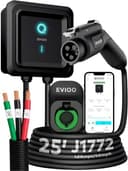 EVIQO 48A Level 2 Charger A lot of charger for the money: a full 48 amps, WiFi with scheduling, ENERGY STAR, and the longest usable reach in this group thanks to a 25 ft cable plus a 40-inch input lead. A strong value alternative to Emporia if you want maximum reach. | ENERGY STAR with app scheduling | |
| 2 | 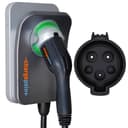 ChargePoint Home Flex The safest default for most homes: you set the amperage in the app to 16, 24, 32, 40, 48 or 50A, so one charger fits whatever circuit your panel can spare today and scales up if you upgrade later. The app is the most mature here, firmware arrives over the air, and the warranty is long. | ENERGY STAR, and stores 90 days of sessions offline | $516.71 · View on Amazon Price as of October 18, 2026. #ad How we’re funded |
| 3 | 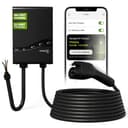 Emporia Pro The answer to a panel that says no. The Pro ships with Emporia's Vue 3 energy monitor in the same box, watches what the rest of the house is drawing, and throttles the car in real time so the total never exceeds what the service can carry — which is how a 48-amp charger ends up on a panel that a load calculation says has no room for one. You pay roughly Home Flex money for it, and only the load management justifies that. | ENERGY STAR with whole-home load management | $599.00 · View on Amazon Price as of October 18, 2026. #ad How we’re funded |
| 4 | 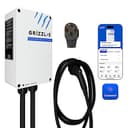 Grizzl-E Classic Connect 40A Grizzl-E's cast-aluminum build with a WiFi radio in it. You get the IP67 body and the cold-flexible 25 ft cable that made the brand's name, plus scheduling, usage history and utility demand-response programs in the Grizzl-E Connect app — in a plug-in unit that comes off the wall when you move. The amperage is still set with a DIP switch, which is either charmingly honest or annoyingly analog depending on your taste. | Scheduling in a sealed IP67 body | $349.99 · View on Amazon Price as of October 18, 2026. #ad How we’re funded |
Frequently asked questions
Is it bad to leave an EV plugged in overnight?
No. Overnight charging at home is the normal pattern - the US DOE's own guidance on home charging is that most owners charge overnight on Level 1 or Level 2. The car finishes its session when it reaches its charge limit and then stops drawing current; it does not keep pushing energy into a full battery.
Is it OK to leave an EV plugged in all the time?
For the equipment, yes. The question worth asking is what charge level you are leaving it at, because that is a battery-care decision rather than a charger decision - set the limit in the car's own menu and follow your manufacturer's guidance for your specific vehicle, which is the only authority on your battery. Leaving the car connected at a sensible limit is also what lets it precondition on shore power instead of on the battery.
Does an EV charger use electricity when it is not charging?
A small amount, continuously. That standby draw is precisely what the ENERGY STAR programme measures: ENERGY STAR states certified chargers use about 40% less energy in standby than non-certified units. Given a home charger spends the overwhelming majority of the day idle, that 40% is the certification's main practical benefit - and it is one of the reasons we run a dedicated ENERGY STAR roundup.
Should I unplug my EV charger when I go on holiday?
There is no safety reason to. The only arguments are the standby draw, which is small, and surge exposure, which is the same as for your other large appliances and better addressed with whole-home surge protection than by unplugging things. If the car is going to sit for weeks, the useful question is what state of charge to leave it at, which is in your vehicle's manual.
Is it better to leave an EV plugged in during cold weather?
Generally yes, and the DOE/EPA say why: preheating the cabin while the car is still plugged in extends range, because the heating energy comes from the wall rather than the battery. Their cold-weather figures are striking - EV range can drop about 41% in mixed driving at 20F versus 75F with the cabin heater running, against about 12% with the heater off. Staying connected is how you keep that cost off the battery.
Does leaving an EV plugged in keep the battery warm?
On many EVs the battery thermal management can run on shore power while the car is connected, which is the same principle as preconditioning the cabin. Whether and how your car does it is vehicle-specific, so check your own manual rather than assuming - we are not going to make a claim about a car we have not got documentation for.
Sources
- U.S. DOE Alternative Fuels Data Center — Charging Electric Vehicles at Home — US DOE on home EV charging: most owners charge overnight on Level 1 or Level 2, installs follow NEC Article 625, with example home-charging costs (accessed July 19, 2026)
- ENERGY STAR — Electric Vehicle Chargers — ENERGY STAR on EVSE efficiency: certified chargers use about 40% less energy in standby than non-certified units (accessed July 19, 2026)
- FuelEconomy.gov — Fuel Economy in Cold Weather (U.S. DOE / EPA) — DOE/EPA on cold weather: EV range can drop about 41% in mixed driving at 20F versus 75F with the cabin heater running (about 12% with the heater off), roughly two-thirds of the extra energy goes to heating the cabin, and preheating while still plugged in extends range (accessed July 20, 2026)
- U.S. DOE Alternative Fuels Data Center — Electric Vehicle Charging Stations — US DOE on charging levels: Level 1 (~1.9 kW, ~5 mi/hr), Level 2 (2.9-19.2 kW, ~7.2 kW typical residential, ~25 mi/hr), and DC fast charging (accessed July 19, 2026)
- U.S. Energy Information Administration — Electricity prices and factors affecting prices — EIA on US electricity pricing: residential electricity averaged 17.30 cents per kWh in 2025; some utilities offer time-of-day pricing to reduce peak demand; prices are usually highest in summer, and the cost to supply electricity is higher in the afternoon and early-evening peak hours even though most customers pay a seasonal average rate (accessed August 11, 2026)
- ChargePoint — Home Flex datasheet (PDF) — ChargePoint's own datasheet: enclosure rating Type 3R per UL 50E, operating temperature -22F to 122F, 23 ft cable, plus installer notes that an outdoor plug-in install requires an outdoor-rated GFCI breaker upstream while an external GFCI may conflict with the charger's internal ground-fault protection on a hardwired install. RE-READ September 3, 2026 for the review refresh: the same datasheet also publishes maximum 12 kW (240V AC x 50A) with output amperage adjustable via the mobile app to 16A, 24A, 32A, 40A, 48A or 50A; a required dedicated dual-pole breaker rated for 125% of maximum load; 'Software Updates: Firmware updated over-the-air (OTA)'; 2.4/5 GHz Wi-Fi (802.11 a/b/g/n); local storage of up to 90 days of charging session data (100 sessions) if the network drops; power measurement accuracy +/- 2.0%; ground-fault detection by 20 mA CCID with auto retry; and UL and cUL listing per UL 2594, UL 2231-1 and UL 2231-2, NEC Article 625 compliant. Ordering information lists the plug-in station models CPH50-NEMA6-50-L23 and CPH50-NEMA14-50-L23 (accessed September 3, 2026)
- Emporia - EV Chargers (Classic vs Pro) — Emporia's own Classic-vs-Pro comparison page: both units publish a 25 ft cable, 'NEMA Plug or Hardwire' installation, 'Up to 48A' and a 3-year warranty. The feature rows list Smart Scheduling, Home Energy Monitoring, Solar Charging Integration, Peak Demand Management and PowerSmart Load Management, footnoted for the Classic as 'Requires Vue Home Energy Monitor' and for the Pro as 'Requires Vue Home Energy Monitor and PowerSmart upgrade'. The Classic section states 'Add the Vue Home Energy Monitor and we'll manage Peak Demand and automatically charge with your excess solar power', and Emporia's platform lists 'Excess Solar Management' as a named feature. The page also states 'PowerSmart comes standard with the Emporia Pro, but can be added to the Emporia Classic for an extra cost'. Emporia's own listed prices on the date accessed are not reprinted here. RE-READ October 17, 2026 for the smart-home roundup: every figure above is unchanged, the page additionally publishes 'Intelligent Load Sharing' for multiple chargers on one circuit and an in-app assistant ('Ask questions about your energy usage and get instant answers'), and it names NO third-party or smart-home integration of any kind - no Alexa, Google Home, Apple Home / HomeKit, Matter, Home Assistant, IFTTT, OCPP or public API appears anywhere on it (accessed October 17, 2026)
- United Chargers — Grizzl-E Classic Connect 40A product overview — Grizzl-E's own overview for the Classic Connect: 'the Wi-Fi Connected Smart Level 2 EVSE for home use' at 40A / 9.6 kW, shipping with the Grizzl-E Connect app for charging statistics, schedules, Demand/Response utility programs, remote control, lockout to prevent unauthorized use, updates and diagnostics; a UL Type 4 water-resistant cast aluminum enclosure with IP67 sealing, a NEMA 14-50 input cable and a 25 ft output cable with a J1772 or NACS connector, 'UL Tested and Certified' with built-in GFCI, over-current, over-voltage, ground-fault and over-temperature protections, and adjustable maximum current set with DIP switches at 40A / 32A / 24A / 16A for a 50A / 40A / 30A / 20A breaker. No ENERGY STAR certification and no OCPP support are published for this model (accessed September 3, 2026)
- FuelEconomy.gov — Electric Vehicles: Learn More About the Label — DOE/EPA on EV efficiency: kWh per 100 miles and MPGe, accounting for AC charging losses (accessed July 19, 2026)
Keep reading
Level 2 and battery health
The worry underneath this question, answered with the published DOE position -- including what it declines to claim.
Read the guideTime-of-use rates and overnight charging
Why when you charge can matter more than how fast, and how to set a schedule that lands in the cheap window.
Read the guideBest ENERGY STAR chargers
The certification that is specifically about standby draw - the thing a plugged-in charger does all day.
See the picksWhat winter charging costs
The DOE's cold-weather range figures, costed - and why preconditioning on shore power is free range.
Read the guideWhat happens when you plug in
The handshake between car and charger, which is what makes 'plugged in' and 'charging' two different states.
Read the guide