The Charger Is Inside Your Car
The single most useful fact in home charging, and the one almost every product page obscures: the wall unit does not charge your car. It supplies AC power, and the car decides what to do with it.
How this is funded: we earn a commission if you buy through our links, at no extra cost to you. It never changes which product we recommend, and we’ll tell you when we’d skip one. Full disclosure.
Here is the sentence that saves people the most money on this entire site: the thing on your wall is not the charger.
Its formal name is electric vehicle supply equipment— EVSE. It supplies AC power and manages the safety of doing so. The actual charger, the component that converts alternating current from your house into the direct current a battery can store, lives inside the car. And its rating, in kilowatts, is an absolute ceiling that no wall unit can raise.
Once that lands, a whole category of confusion disappears. Why the 48-amp charger did not make your car faster. Why two neighbors with identical chargers report different charging times. Why an 80-amp unit is, for almost everyone, an expensive 48-amp unit.
What the wall unit actually does
It is not nothing. The EVSE handles four jobs, and they are the reason you cannot simply run a heavy extension cord to the car:
- It verifies the connectionbefore anything is energized, using the SAE J1772 signaling scheme — the pins are dead until the car and the charger have agreed they are properly mated.
- It advertises the circuit’s capacity. This is the important one. The EVSE continuously tells the car the maximum current it may draw, and the car obeys. That is how one adjustable charger safely serves a 20-amp circuit or a 60-amp one.
- It energizes the cable only while a car is attached and charging, so a connector left lying in a puddle is not live.
- It monitors for faults— ground faults, over-temperature, loss of the pilot signal — and disconnects.
What it never does is decide how fast to charge. It states a limit. The car chooses a number at or below that limit, capped by its own onboard charger. The full choreography is in what happens when you plug in.
The ceiling, in numbers
Onboard chargers cluster around a handful of ratings. Find the row nearest your car’s published figure and read across — the last column is the point of the whole page.
| Onboard charger | Amps it will draw | Range per hour | Buying a bigger charger gains you |
|---|---|---|---|
| 3.3 kW | ~14 A | ~12 mi/hr | Nothing above ~14 A |
| 6.6 kW | ~28 A | ~23 mi/hr | Nothing above ~28 A |
| 7.2 kW | ~30 A | ~25 mi/hr | Nothing above ~30 A |
| 7.7 kW | ~32 A | ~27 mi/hr | Nothing above ~32 A |
| 9.6 kW | ~40 A | ~34 mi/hr | Nothing above ~40 A |
| 11.5 kW | ~48 A | ~40 mi/hr | Nothing above ~48 A |
| 19.2 kW | ~80 A | ~67 mi/hr | Nothing above ~80 A |
Two conversions are worth memorizing. kW ÷ 240 × 1,000 = amps turns a spec-sheet rating into a shopping number. And amps × 0.8 — the NEC continuous-load rule — turns a breaker size into the charging current it supports, which is the other half of the decision. For a worked example of a single model sold with two different ratings, see our Cadillac LYRIQ charger picks, where the trim decides between a 60-amp and a 100-amp circuit. For the simpler and far more common case — one rating across the whole range, so the shopping stops at one number — see our Kia EV9 charger picks: Kia publishes 10.9 kW on every trim, which is about 45 amps and settles the purchase at 48. Some manufacturers publish the ceiling as an acceptance rate rather than a module rating — Volkswagen states a maximum AC acceptance rate of 11 kW for the ID.4, which is the same arithmetic reached from the other direction, and our Volkswagen ID.4 charger picks work it through alongside the 9.6 kW cable VW already ships with the car.
Why the limit exists at all
Converting AC to DC at these power levels needs real hardware: rectifiers, filtering, cooling, and a control system that protects the pack. All of it has weight, cost and volume, and it rides around in the car for its entire life whether you use its full capacity or not.
So manufacturers size it to what home and workplace charging plausibly need, not to the maximum imaginable. A car that will spend its nights on a 40-amp circuit gains very little from an 11.5 kW onboard charger and pays for it in mass and money forever. That is a defensible engineering trade, even when it is frustrating on the day you install a big charger.
And it is precisely why DC fast charging exists in the form it does. A roadside DC charger contains the conversion hardware itself and feeds DC to the battery directly, bypassing the onboard charger entirely — which is how a car with an 11 kW onboard charger accepts 150 kW on a road trip. That equipment is far too large, hot and expensive to bolt to a garage wall, which is the honest answer to “why can’t I have fast charging at home?” We cover it in AC vs DC charging.
What to do with this
Look the number up before you shop.It takes two minutes in the owner’s manual and it eliminates most of the charger market from consideration immediately. A car rated 7.7 kW has no use for anything above 32 amps, ever.
Then take the lowest of three numbers,not just this one. Your car’s ceiling, your panel’s spare capacity, and what your daily driving actually requires — the useful charger size is the smallest of the three. That is the method in what size charger do I need.
Buy adjustability rather than headroom. The one legitimate reason to exceed your current ceiling is a future car, and the cheap way to hedge that is a charger with a wide adjustable output rather than a bigger circuit. Conductors and breakers cost real money; a setting costs nothing.
Quick picks
Ranked on published specs, charging speed, electrical fit and value. Select a row to jump to the full write-up. We have not bench-tested these chargers — here is exactly what we do instead.
| # | Product | Best for | Price |
|---|---|---|---|
| 1 | 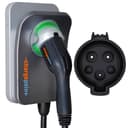 ChargePoint Home Flex The safest default for most homes: you set the amperage in the app to 16, 24, 32, 40, 48 or 50A, so one charger fits whatever circuit your panel can spare today and scales up if you upgrade later. The app is the most mature here, firmware arrives over the air, and the warranty is long. | Widest range — 16A to 50A in the app | $516.71 · View on Amazon Price as of October 17, 2026. #ad How we’re funded |
| 2 | 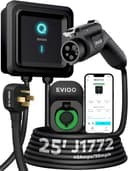 EVIQO 40A NEMA 14-50 Charger The most charger you can get without an electrician's invoice. It plugs into a NEMA 14-50 outlet for a full 40 amps, keeps the WiFi app, the ENERGY STAR listing and the 25 ft cable from EVIQO's hardwired unit, and can be unplugged and taken with you when you move. | 6A to 40A on a plug-in install | |
| 3 |  Emporia Level 2 EV Charger The value pick that doesn't feel cheap: a full 48 amps, ENERGY STAR listing, WiFi with genuine energy monitoring, and a 25 ft cable — for well under what the big names charge. It's the one we point most people to first. | 48A hardwired or 40A plugged in, one unit |
A last note for the group this page most often surprises: plug-in hybrid owners. PHEV onboard chargers are typically much smaller than a full EV’s, and DOE notes most plug-in hybrids cannot DC fast charge at all — so the onboard charger is the only limit that will ever apply to them. Our PHEV roundup is built around exactly that, and it is the clearest case where the cheapest adequate charger is also the correct one.
Frequently asked questions
What is an onboard charger?
The equipment inside the vehicle that converts AC power from the wall into the DC the battery stores, and controls how fast that happens. Its rating in kilowatts is a hard ceiling on AC charging speed — the wall unit can never push more into the car than the onboard charger will accept.
So what is the box on my wall?
Formally it is electric vehicle supply equipment, or EVSE. It is a safety-managed switch: it verifies a good connection, tells the car how much current the circuit can safely supply, energizes the cable, and cuts power if anything goes wrong. It supplies AC, it does not convert it.
How do I find my car's onboard charger rating?
The owner's manual and the manufacturer's specification page both publish it, usually in kilowatts and sometimes as a maximum AC amperage. To convert kW to amps, multiply by 1,000 and divide by 240 — so 11.5 kW is about 48 amps, 7.7 kW is about 32, and 3.3 kW is about 14.
Will a 48-amp charger charge my car faster than a 40-amp one?
Only if the car accepts more than 40 amps. If your onboard charger is rated 7.7 kW, it will draw about 32 amps from either unit and the sessions will be identical. If it is rated 11.5 kW, the 48-amp charger is genuinely about 20% faster — worth having, and worth the 60-amp circuit it requires.
Why does DC fast charging bypass this limit?
Because a DC fast charger does the AC-to-DC conversion in the roadside cabinet and feeds DC straight to the battery, skipping the onboard charger entirely. That is the whole reason it can deliver 150 kW to a car whose onboard charger is rated 11 kW — and why nothing like it exists for a house.
Can I upgrade my car's onboard charger?
Not practically. It is an integrated high-voltage component, and on some vehicles the rating is a factory option tied to a trim or a battery pack. Treat it as fixed for the life of the car, and size your home charger around it.
Sources
- U.S. DOE Alternative Fuels Data Center — Electric Vehicle Charging Stations — US DOE on charging levels: Level 1 (~1.9 kW, ~5 mi/hr), Level 2 (2.9-19.2 kW, ~7.2 kW typical residential, ~25 mi/hr), and DC fast charging (accessed July 19, 2026)
- SAE International — J1772 Conductive Charge Coupler — The SAE J1772 connector standard for AC Level 1 and Level 2 charging in North America (accessed July 19, 2026)
- U.S. DOE Alternative Fuels Data Center — Charging Electric Vehicles at Home — US DOE on home EV charging: most owners charge overnight on Level 1 or Level 2, installs follow NEC Article 625, with example home-charging costs (accessed July 19, 2026)
- FuelEconomy.gov — Electric Vehicles: Learn More About the Label — DOE/EPA on EV efficiency: kWh per 100 miles and MPGe, accounting for AC charging losses (accessed July 19, 2026)
- NFPA — Using the Latest NEC for EV Charger Installations — NFPA on NEC (NFPA 70) Article 625: EV charging is a continuous load, so circuits are sized to 125% of load (the 80% rule) (accessed July 19, 2026)
- U.S. DOE Alternative Fuels Data Center — Electric Vehicles for Consumers — US DOE on connector types: J1772 for Level 1/2, and CCS, CHAdeMO or NACS (J3400) for DC fast charging (accessed July 19, 2026)
Keep reading
Best chargers for the Toyota bZ
A worked example: Toyota publishes 11 kW, which is why 48 amps is the ceiling worth paying for.
See the bZ picksWhat size charger do I need?
Your car's ceiling is one of three numbers. Take all three, then take the lowest.
Work it outAC vs DC charging
Why home charging tops out where it does, and how DC fast charging sidesteps the limit entirely.
See the difference40 amps vs 48 amps
The decision this page usually settles — and the circuit difference that comes with it.
Compare the two48 amps vs 80 amps
The clearest case of buying capacity a car cannot use. Worth reading before the top tier tempts you.
Read the argument