Can an EV Charger Get Wet?
An outdoor-rated charger is built to live in the weather, and the people who make them say so plainly. But 'weatherproof' is not one thing - the ratings separate rain from windblown dust from hose water from immersion, and the part of the system most likely to end up underwater is not the part with the rating.
How this is funded: we earn a commission if you buy through our links, at no extra cost to you. It never changes which product we recommend, and we’ll tell you when we’d skip one. Full disclosure.
Yes — an outdoor-rated EV charger is designed to get rained on, snowed on and left out year-round, and charging in the rain is safe. The caveats are all about which kind of wet. A rating is not a blanket promise of waterproofing; each code names specific hazards, and a unit specified against rain may not be specified against the hose you are about to point at it. The other thing worth knowing is that the component most likely to end up genuinely submerged is the connector handle, lying on the ground where you dropped it — and that is a habit problem, not a spec problem.
Why rain is not the hazard it feels like
The intuition that electricity plus water equals danger is sound in general and misleading here, because of how a Level 2 charger behaves before it does anything. The pins in the connector are dead until the charger and the car have completed a handshake over a dedicated pilot wire — the charger confirms the connector is properly seated, confirms a sound ground path, agrees a current limit with the car, and only then closes the contactor and energises the cable. Pull the connector out mid-session and it de-energises before the pins separate. We cover that sequence in what happens when you plug in, and it is the single best answer to the rain question.
On top of that sits the ground-fault protection every listed charger carries. ChargePoint’s datasheet publishes ground-fault detection by a 20 mA CCID with auto retry; Wallbox publishes an integrated CCID20 with ground monitoring. Those devices exist precisely for the case where moisture creates a leakage path, and they act in milliseconds. Our GFCI guide explains what they are and why adding a second, more sensitive one upstream causes problems.
What each rating actually covers
There are two systems and they do not convert into each other. NEMA’s own definitions put it like this:
- Type 3R— falling dirt, and rain, sleet and snow. This is the rating on the ChargePoint Home Flex. It covers weather falling out of the sky and nothing more.
- Type 4— everything in 3R plus windblown dust, splashing water and hose-directed water. Emporia, Wallbox, Autel’s 40A and the EVIQO units publish Type 4 or an equivalent.
- Type 4X— Type 4 plus protection against corrosion. The Autel MaxiCharger Home publishes this, which is a coastal and road-salt spec more than a water spec.
On the IP side, the two digits do separate jobs. A first digit of 6 is dust-tight. A second digit of 6 is protection against powerful water jets. A second digit of 7 is protection against temporary immersion — and, crucially, IEC 60529 is explicit that a 7 alone does not imply water-jet protection unless the product is dual-coded. So IP67 is not simply a better IP66; they are tested against different hazards. Grizzl-E publishes IP67 alongside a UL Type 4 rating, which is the dual-coded case done properly; the Ampure Go publishes IP67 with a NEMA 6P watertight enclosure and describes it as submersible up to three feet. NEMA itself states that its NEMA-to-IP table cannot be used to convert IP designations back to NEMA types, which is why we never translate between them. The full treatment is in our ratings explainer.
Two units in our registry publish noenclosure rating at all — the Lectron 40A portable and the Lectron NACS portable, the second of which Lectron describes as weather-resistant for indoor or outdoor use while advising against extreme weather exposure. That is a finding, not a gap in our research, and it is a good reason not to make either the permanent outdoor unit.
The mounting mistake that voids the rating
An enclosure is rated in the orientation it was designed to be installed in. Grizzl-E’s manual states the point outright: the enclosure’s water rating cannot be guaranteed if the unit is mounted upside down. Seals, internal drainage paths and the direction cable glands face all assume gravity points the way the designer expected. Rotate the box to make the cable exit on a more convenient side and you may have quietly downgraded a Type 4 unit to an unrated one.
The same logic applies to the cable. Dress it so water runs awayfrom the entry point rather than down the cable into it — a drip loop below the gland is the standard answer. And give the connector a home: Lectron supplies a J-hook and plug holder with the Nexus units, ELEGRP ships a wall-mounted holder and a carry bag, Autel builds an in-body holster into the 40A, and Grizzl-E includes a holster. Use it. Our placement guide covers height and orientation properly.
Snow, ice and standing water
Snow on the enclosure is covered by any outdoor rating, including Type 3R. The problems in winter are elsewhere: a connector left on the ground that freezes into the ice, a cable that has gone stiff enough to fight you, and a charge port with meltwater in it. Store the handle in its holster so neither the cable nor the connector ends up as part of the driveway, and expect published cold ratings to be about the equipment surviving rather than the car charging quickly — in genuine cold the battery, not the charger, is the limit. Our cold-weather roundup covers which cables stay flexible, and winter charging costs covers what the season does to your bill.
Standing water is the one case to take seriously. No home charger is specified for installation in a location that floods, and a unit that has been underwater should be inspected by an electrician rather than switched back on — the same advice that applies to any submerged appliance. Mount high enough that the bottom of the enclosure clears anything your driveway does in a heavy storm.
Chargers specified for a wall with no roof over it
If the charger genuinely lives outside, buy the rating rather than hoping. These four publish the strongest weather specifications of anything we list, and all four are ranked in full on our outdoor roundup.
| Spec | Autel MaxiCharger Home | EVIQO 48A Level 2 Charger | Grizzl-E Classic Connect 40A | Ampure Go Portable Level 2 Charger |
|---|---|---|---|---|
| Enclosure | IP65 / NEMA 4X | IP66 / NEMA 4 | NEMA 4 (IP67) | IP67 (NEMA 6P watertight) |
| Outdoor rated | Yes | Yes | Yes | Yes |
| Install | Hardwired | Hardwired | NEMA 14-50 plug | NEMA 14-50 cord for 240V, NEMA 5-15 cord for 120V |
| Cable length | 25 ft | 25 ft | 25 ft | 20 ft |
| Listings | CSA certified, ENERGY STAR | UL, ETL, FCC, ENERGY STAR | UL/cUL listed (file E510712) | UL and cUL listed (UL 2594 / UL 2231 / UL 817), ENERGY STAR, FCC |
Quick picks
Ranked on published specs, charging speed, electrical fit and value. Select a row to jump to the full write-up. We have not bench-tested these chargers — here is exactly what we do instead.
| # | Product | Best for | Price |
|---|---|---|---|
| 1 | 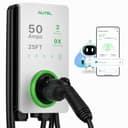 Autel MaxiCharger Home Built for the harshest driveway. The NEMA 4X enclosure is rated to keep charging in extreme cold and heat, it pushes a full 50 amps, and the app is capable. If your charger lives fully exposed to the weather, this is the one. | NEMA 4X: adds corrosion protection | |
| 2 | 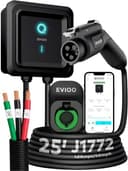 EVIQO 48A Level 2 Charger A lot of charger for the money: a full 48 amps, WiFi with scheduling, ENERGY STAR, and the longest usable reach in this group thanks to a 25 ft cable plus a 40-inch input lead. A strong value alternative to Emporia if you want maximum reach. | IP66 / NEMA 4, published -22F to 122F | |
| 3 | 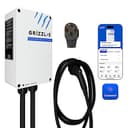 Grizzl-E Classic Connect 40A Grizzl-E's cast-aluminum build with a WiFi radio in it. You get the IP67 body and the cold-flexible 25 ft cable that made the brand's name, plus scheduling, usage history and utility demand-response programs in the Grizzl-E Connect app — in a plug-in unit that comes off the wall when you move. The amperage is still set with a DIP switch, which is either charmingly honest or annoyingly analog depending on your taste. | UL Type 4 with IP67 sealing, plug-in | $349.99 · View on Amazon Price as of October 18, 2026. #ad How we’re funded |
| 4 | 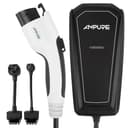 Ampure Go Portable Level 2 Charger The only portable charger we track that is certified like a permanent one. UL 2594 / UL 2231, ENERGY STAR and an IP67 / NEMA 6P body rated from -22F to 122F, in a nine-pound module that ships with a NEMA 14-50 cord for 240V and a standard 5-15 cord for 120V. You give up eight amps against the 40A units and get, in exchange, a charger genuinely rated to live in a trunk and be rained on. | IP67 and NEMA 6P, for a portable left outdoors | $299.00 · View on Amazon Price as of October 18, 2026. #ad How we’re funded |
Frequently asked questions
Can you charge an EV in the rain?
Yes. The connector and the charge port are designed to mate and carry current outdoors, and the charger does not energise the pins until it has confirmed the connector is properly seated and the ground path is intact - that handshake is why rain is not a hazard. What matters is that the equipment is rated for outdoor installation, which the manufacturer publishes as a NEMA type or an IP code.
Is it safe to charge an EV in a thunderstorm?
Charging itself is no more hazardous in a storm than in drizzle - the protection is the same. The real storm risk is to the equipment rather than to you, from a surge on the supply side, and it is the same risk your other large appliances face. If your area takes frequent strikes, whole-home surge protection is a question for your electrician, not a charger feature.
What happens if the EV charging connector falls in a puddle?
Pick it up, shake the water out of the handle, and look at the contacts before you plug it into the car. A sealed outdoor connector is built to survive it, but no manufacturer intends the handle to be stored in standing water, and grit carried in with the water is as much of a problem as the water itself. This is exactly what the holster or J-hook that comes in the box is for - Lectron, Grizzl-E, ELEGRP and Autel all supply one.
Can I pressure-wash or hose near my EV charger?
Only if the enclosure rating covers it, and most do not. NEMA Type 3R protects against falling dirt and rain, sleet and snow - not hose-directed water. Type 4 does add windblown dust, splashing and hose-directed water. On the IP side, a second digit of 6 means protection against powerful water jets. So a Type 4 or IP66 unit is specified for a hose and a Type 3R unit is not.
Does IP67 mean an EV charger is waterproof?
It means it survived temporary immersion in a test, which is not the same as being better than IP66 in every way. Under IEC 60529, a second digit of 7 covers temporary immersion but does not imply water-jet protection unless the product is dual-coded. A unit rated IP66 is specified against powerful jets; a unit rated IP67 alone is not. Our ratings explainer covers this trap in detail.
Can I mount an outdoor EV charger upside down?
No, and one manufacturer says so explicitly. Grizzl-E's own manual carries a caution that the enclosure's water rating cannot be guaranteed if the unit is mounted upside down. Enclosures are rated in the orientation they are designed to be installed in, because seals, drainage paths and cable entries all assume gravity points the way the designer expected.
Sources
- NEMA — Enclosure Types (definitions from NEMA 250) — NEMA's own definitions: Type 3R protects against falling dirt and rain, sleet and snow; Type 4 adds windblown dust, splashing and hose-directed water; Type 4X adds protection against corrosion. NEMA also states its NEMA-to-IP table cannot be used to convert IP designations back to NEMA types (accessed July 20, 2026)
- IEC 60529 — Degrees of protection provided by enclosures (IP Code), full text — The IP code standard (verbatim national adoption, IS/IEC 60529:2001): first numeral 6 = dust-tight; second numeral 6 = protected against powerful water jets; second numeral 7 = protected against temporary immersion, and a 7 alone does not imply water-jet protection unless dual coded (accessed July 20, 2026)
- United Chargers — Grizzl-E Classic user manual (PDF) — Grizzl-E's own manual: NEMA 4 indoor/outdoor installation rating, operating temperature -22F to 122F, a caution that the enclosure's water rating cannot be guaranteed if the unit is mounted upside down, and a note to use a 20mA GFCI breaker where one is required because a 5mA breaker may cause disruptions (accessed July 20, 2026)
- United Chargers — Grizzl-E Classic 40A product page — Grizzl-E's own current product data for the Classic, re-read September 28, 2026 and unchanged since the September 3 and August 20 readings: Type 1 (SAE J1772) AC Level 2, 40 A, plug types 'NEMA 14-50, NEMA 6-50', UL Type 4 indoor/outdoor rating, certifications 'UL E510712, Energy Star', smart function 'No Internet Connection', 25 ft (7.6 m) output cable, operating temperature -30C to +50C (-22F to 122F), 3-year default warranty, aluminum enclosure, and three finishes — 'Classic Black, Avalanche White, or Extreme Camo'. Grizzl-E sells it directly at $299.99 and it is listed on Amazon again as of the same date (accessed September 28, 2026)
- Autel Energy — MaxiCharger AC Elite Home 50A product page — Autel's own listing: compliant with NEMA 4X standards, operating temperature -40F to 131F, 25 ft cable, 3-year warranty. RE-READ October 10, 2026 for the Emporia head-to-head, and the page now publishes materially more: 'Maximum Output | 12 kW / 50 A' with output 'Adjustable 16-50 A'; installation given as 'Hardwired - 70 A Circuit for Full Output'; an 'SAE J1772' connector; an enclosure rating of 'IP65 / NEMA 4X'; an operating range of '-40 to 131 F (-40 to 55 C)'; a '3 Years' warranty quoted as a single term with no component split; 'CSA and ENERGY STAR compliance' (no UL listing is claimed on this page); connectivity listed as 'Bluetooth, Wi-Fi, Ethernet, CAN, RS485'; app control to start, stop and schedule charging, monitor activity and adjust current; dimensions of 13.2 x 7.4 x 3.8 in (336 x 187 x 97 mm) and a weight of 15.4 lbs (7 kg); and the load-management sentence this comparison turns on - 'Supports both Adaptive Load Management (ALM) and charger-to-charger Dynamic Load Balancing (DLB). ALM requires compatible additional hardware, while DLB works between chargers without additional hardware.' The page publishes no solar-specific feature (accessed October 10, 2026)
- EVIQO — Level 2 EV Charger, 40A (9.6 kW), NEMA 14-50 plug-in (Gen 2) — EVIQO's own product page: 40A / 9.6 kW on a NEMA 14-50 plug, SAE J1772, 25 ft charging cable plus a 40 in input cable, IP66 / NEMA 4 enclosure, UL / ETL / FCC / ENERGY STAR listings, 3-year standard warranty, app-adjustable 6-40A output, and a note that it needs an EV-grade 4-prong 14-50 receptacle rather than a dryer outlet. RE-READ September 15, 2026 for the garage roundup: the page additionally states an operating temperature range of -22F to 122F, that the app needs a 2.4 GHz WiFi connection, that the standard 3-year warranty is extendable to 4, and that the unit ships in 1-2 business days (accessed September 15, 2026)
- Lectron — NEXUS Level 2 J1772 EV Charging Station, 240V, 48 Amp, Hardwired — Lectron's own product page: up to 48 A continuous at 240 V for 11.5 kW, hardwire-only install by a licensed electrician on a dedicated 240 V circuit, IP66 weatherproof housing for indoor or outdoor use, 23 ft output cable of 15.0 mm (±0.3 mm) heavy-duty compound the brand states is 'engineered to stay flexible and easy to wrap around the wall mount, even in freezing weather', wall-mount J-hook and plug holder included, ETL listed to UL 2594 / UL 2231 / UL 2251 with ENERGY STAR and FCC certification, and a 3-year Lectron warranty. No operating-temperature range and no Wi-Fi or app support are published for this model (accessed August 20, 2026)
- Ampure - Ampure Go portable Level 2 EV charger product page — Ampure's own specifications for the Go: 32 A / 7.7 kW at 240 V or 12 A / 1.4 kW at 120 V, input range 85-265 VAC at 45-65 Hz, SAE J1772 coupler, NEMA 14-50 and NEMA 5-15 cords, 20 ft (6 m) cable, IP67 rated 'submersible up to 3 feet' with a NEMA 6P watertight enclosure, operating range -30C to +50C (-22F to 122F), 9 lb (4.1 kg) module, and listings to UL, cUL, UL 2594, UL 2231, UL 817, ICES, FCC, ENERGY STAR, REACH and RoHS. Ampure states 'up to 25 miles of range per hour' at 240 V. RE-READ October 10, 2026 for the review: every figure above is unchanged on the page. Confirmed again that this page publishes NO warranty term (that figure is on the store listing), NO app, WiFi or scheduling feature, and NO description of the unit's internal safety protections (no GFCI / CCID figure, no over-temperature behavior). The page describes the unit as an 'IP67-rated IC-CPD', i.e. an in-cable control and protection device, and the specification block gives the plug types as 'NEMA 14-50 & NEMA 5-15' alongside an 'IEC grid plug'. Ampure's current line separates this unit from a distinct 'Go 2 (NACS)' model; the specifications above are the Gen 1 J1772 unit Amazon lists as the 'Go 1' (accessed October 10, 2026)
- Lectron - EV Charging FAQ — Lectron's own FAQ, read for its plug-and-cord guidance: 'It's recommended to plug the charger directly into a dedicated outlet without extension cords', with a safety list that reads 'Always match plug and outlet ratings (volts/amps)', 'Use GFCI protection for outdoor plugs', 'Avoid extension cords or daisy-chaining', 'Inspect plugs and cables regularly' and 'Hire a licensed electrician for installation'. Its NEMA table publishes 5-15 as 120V / 15A, 5-20 as 120V / 20A, 6-20 as 240V / 20A, 10-30 / 14-30 as 240V / 30A ('Common in older dryers') and 14-50 as 240V / 50A, and states that Lectron offers NEMA 5-15, 14-50 and 10-30 plug options for portable charging. Also states that a Tesla owner can use the J1772-to-Tesla adapter 'included with most Tesla', and that adapters 'don't generate power - they only enable compatibility between chargers and vehicles' (accessed September 17, 2026)
- ChargePoint — Home Flex datasheet (PDF) — ChargePoint's own datasheet: enclosure rating Type 3R per UL 50E, operating temperature -22F to 122F, 23 ft cable, plus installer notes that an outdoor plug-in install requires an outdoor-rated GFCI breaker upstream while an external GFCI may conflict with the charger's internal ground-fault protection on a hardwired install. RE-READ September 3, 2026 for the review refresh: the same datasheet also publishes maximum 12 kW (240V AC x 50A) with output amperage adjustable via the mobile app to 16A, 24A, 32A, 40A, 48A or 50A; a required dedicated dual-pole breaker rated for 125% of maximum load; 'Software Updates: Firmware updated over-the-air (OTA)'; 2.4/5 GHz Wi-Fi (802.11 a/b/g/n); local storage of up to 90 days of charging session data (100 sessions) if the network drops; power measurement accuracy +/- 2.0%; ground-fault detection by 20 mA CCID with auto retry; and UL and cUL listing per UL 2594, UL 2231-1 and UL 2231-2, NEC Article 625 compliant. Ordering information lists the plug-in station models CPH50-NEMA6-50-L23 and CPH50-NEMA14-50-L23 (accessed September 3, 2026)
- UL Solutions — EV Charging Infrastructure Services — UL on EVSE safety certification: ANSI/UL 2594 is the Standard for Electric Vehicle Supply Equipment (accessed July 19, 2026)
Keep reading
NEMA and IP ratings explained
The two rating systems in full, including why you cannot convert one into the other and why IP67 is not simply better than IP66.
Read the explainerBest outdoor chargers
The roundup that ranks on exactly these specs - which units suit a driveway, a carport or a snowbelt winter.
See the picksWhere to mount the charger
Height, orientation and the drip loop - the install details that decide whether the rating does its job.
Plan the placementCharging with no garage
If the charger has no roof over it at all: carports, open driveways and when a post is the answer.
Read the guide