How Many Amps Does an EV Charger Use?
Home chargers draw 12 to 80 amps, and the honest answer to which one you need is a different number than either the spec sheet or the breaker shows. Here are the three figures that get called 'the amps', how to convert between them in one line of arithmetic, and why the ceiling is usually inside your car rather than on your wall.
How this is funded: we earn a commission if you buy through our links, at no extra cost to you. It never changes which product we recommend, and we’ll tell you when we’d skip one. Full disclosure.
Home EV chargers draw between 12 and 80 amps, and in practice almost everyone buys 40 or 48. But that is not really what you asked, because three different numbers get called “the amps” and mixing them up is how people end up buying a charger their panel cannot feed. Let us separate them first, because once they are separate the rest of this is one line of arithmetic.
One: the rated amperage.The number on the box — 40 A, 48 A. It is the maximum current the charger is built to deliver.
Two: the actual draw. What it pulls right now, which is its configured amperage, not necessarily its rated one. A 48-amp charger set to 24 amps draws 24. And unlike almost everything else in your house, it draws that figure continuously for hours.
Three: the circuit rating. What the breaker and the wire have to be, which is always larger than the draw. This is the number people get wrong, and the gap between two and three is not optional.
The one rule that connects them
EV charging is a continuous load. Electrical code sizes a continuous load’s branch circuit to 125% of the draw— which the industry says backwards as the “80% rule”, meaning a circuit may carry 80% of its rating continuously. Both phrasings are the same arithmetic:
Charger draw × 1.25 = circuit size. Or: circuit size × 0.8 = maximum charger draw.
So a 40-amp charger needs a 50-amp circuit. A 48-amp charger needs 60. An 80-amp charger needs 100. And running it the other way, a 30-amp circuit supports a 24-amp charger, and a 20-amp circuit supports 16.
The reason is heat rather than bureaucracy. A conductor carrying 40 amps for a dryer’s forty minutes behaves very differently from the same conductor carrying 40 amps for ten hours straight. The derating gives the wire, the terminations and the breaker margin to shed heat they would otherwise accumulate. It is the same physics that makes extension cords a bad idea for charging.
| Charger draws | Circuit needed | Power | Range per hour | Where you meet it |
|---|---|---|---|---|
| 12 A (120 V) | 15 A | 1.4 kW | ~5 mi/hr | A standard wall outlet - Level 1 |
| 16 A | 20 A | 3.8 kW | ~13 mi/hr | The lowest step on most adjustable units |
| 24 A | 30 A | 5.8 kW | ~20 mi/hr | A dryer-sized circuit |
| 32 A | 40 A | 7.7 kW | ~27 mi/hr | The Ampure Go portable |
| 40 A | 50 A | 9.6 kW | ~34 mi/hr | Every plug-in unit we track |
| 48 A | 60 A | 11.5 kW | ~40 mi/hr | The hardwired mainstream |
| 50 A | 60 A (70 A per Autel) | 12 kW | ~42 mi/hr | ChargePoint and Autel's top AC units |
| 80 A | 100 A | 19.2 kW | ~67 mi/hr | The Autel MaxiCharger 80A alone |
One row in that table deserves a note, because it is the exception we keep flagging. Autel states that its 50-amp MaxiCharger needs a 70-amp circuit for full output. That is more than the 125% rule implies, it comes from Autel’s own page, and we publish it rather than rounding it down to the 60 amps readers expect. If you are planning around that unit, plan around 70.
Converting amps into something you can use
Amps on their own tell you about your wiring. To learn about your car you need two more conversions, and both are one multiplication. These are our calculations with the assumptions printed, not figures off a box.
Amps to kilowatts:amps × 240 volts ÷ 1000. So 40 amps is 9.6 kW; 48 amps is 11.5 kW; 24 amps is 5.8 kW.
Kilowatts to miles per hour:kW × your car’s miles per kWh. We use a reference 3.5 miles per kWh throughout this site, which is a reasonable mid-range EV in mild weather. So 9.6 kW is about 34 miles of range per hour. A heavy truck in winter might manage 2.0 and a small efficient sedan 4.5, which moves that figure a long way in both directions — our winter charging page has the cold-weather side.
Now the sanity check that makes most amperage anxiety evaporate. The average US driver covers well under 40 miles a day. At 40 amps that is a bit over an hour of charging. At 24 amps it is two. Your car is parked for ten or twelve. Unless you drive unusually far or have an unusually short charging window, you are choosing between “finished by midnight” and “finished by 1am”, and both happen while you are asleep. We work this through properly in what size charger do I need.
The ceiling that makes all of this moot
Here is the part charger listings have no incentive to tell you: the amperage that matters is the lower of what your charger delivers and what your car accepts. And it is usually the car.
Every EV has an onboard charger— the hardware inside the vehicle that converts the AC coming up the cable into DC for the battery. Its rating is a hard ceiling. 11.5 kW is a common figure; plenty of vehicles stop at 7.7 or 11; only a handful accept 19.2. Feed an 11 kW car from an 80-amp charger and you get 11 kW, on a 100-amp circuit you paid a great deal of money for.
We have written six per-vehicle guides and the pattern is consistent. Toyota publishes “11-kW onboard charger” for the bZ. Kia publishes 10.9 kW on every EV6 and EV9 trim. Volkswagen publishes an 11 kW maximum AC acceptance rate for the ID.4. The Cadillac LYRIQ is the rare case where some trims take 19.2 kW. And Hyundai publishes no figure at all for the IONIQ 5— which is why that page derives the ceiling from Hyundai’s own charge times and shows the working.
So the honest shopping order is: find your car’s AC acceptance rate first, then buy a charger that meets or modestly exceeds it, then size the circuit to the charger. Doing it in the other order is how people end up on our fastest-chargers roundup buying 80 amps for a car that will politely decline most of it.
Why adjustable amperage is the feature to want
Given all of the above, the most valuable thing a charger can do about amperage is let you change it. A unit you can configure fits the circuit you have today and the circuit you might have later, and it is the difference between a charger that survives a move and one that does not.
| Charger | Published settings | Rated max | Power at max | Install |
|---|---|---|---|---|
| ChargePoint Home Flex | 16 / 24 / 32 / 40 / 48 / 50 A in the app | 50 A | 12 kW | Hardwired, NEMA 6-50 or NEMA 14-50 |
| Autel MaxiCharger 80A | 6-80 A in the app; DIP 16 / 24 / 32 / 40 / 48 / 50 / 64 / 72 / 80 A | 80 A | 19.2 kW | Hardwired |
| Grizzl-E Classic Connect 40A | 16 / 24 / 32 / 40 A on a DIP switch | 40 A | 9.6 kW | NEMA 14-50 plug |
| ELEGRP 40A Portable Level 2 Charger | 40 / 32 / 24 / 20 / 16 A selectable | 40 A | 9.6 kW | NEMA 14-50 plug |
Two things to note about that table. The mechanism differs: ChargePoint and Autel set current in software, while Grizzl-E and ELEGRP use a physical switch, which means a circuit change is a service visit rather than a tap. And the absences matter: several hardwired units we rate highly — the EVIQO 48A, the Lectron Nexus 48A, the Emporia Pro — publish no adjustable range, so we treat their rated amperage as the configuration you are buying rather than assuming a lower setting exists.
Whatever you buy, get the configured amperage written on the invoice. On the DIP-switch units the setting ends up sealed inside the enclosure where you will never see it again, and a wrong setting is a common cause of a charger that will not charge or a breaker that keeps tripping.
Quick picks
Ranked on published specs, charging speed, electrical fit and value. Select a row to jump to the full write-up. We have not bench-tested these chargers — here is exactly what we do instead.
| # | Product | Best for | Price |
|---|---|---|---|
| 1 | 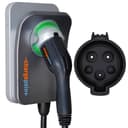 ChargePoint Home Flex The safest default for most homes: you set the amperage in the app to 16, 24, 32, 40, 48 or 50A, so one charger fits whatever circuit your panel can spare today and scales up if you upgrade later. The app is the most mature here, firmware arrives over the air, and the warranty is long. | Widest app-set range, 16-50 A | $516.71 · View on Amazon Price as of October 18, 2026. #ad How we’re funded |
| 2 | 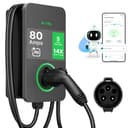 Autel MaxiCharger 80A The ceiling of home AC charging: 19.2 kW on a 100-amp circuit, which is roughly double what a 48-amp charger does. Almost no car can actually take it — most cap their onboard charger somewhere between 7.7 and 11.5 kW — so buy this for a specific vehicle that accepts 80 amps, or for a future-proofed circuit you already have. Otherwise it is a very good, very expensive 48-amp charger. | 6-80 A, the widest we track | |
| 3 | 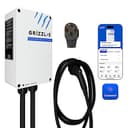 Grizzl-E Classic Connect 40A Grizzl-E's cast-aluminum build with a WiFi radio in it. You get the IP67 body and the cold-flexible 25 ft cable that made the brand's name, plus scheduling, usage history and utility demand-response programs in the Grizzl-E Connect app — in a plug-in unit that comes off the wall when you move. The amperage is still set with a DIP switch, which is either charmingly honest or annoyingly analog depending on your taste. | DIP switch, nothing to log into | $349.99 · View on Amazon Price as of October 18, 2026. #ad How we’re funded |
| 4 | 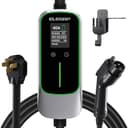 ELEGRP 40A Portable Level 2 Charger The full-speed portable. A genuine 40 amps on a NEMA 14-50, an IP67 station body rated -22F to 122F, and a 25-foot cable - the longest here by five feet - for less than the 32A unit costs. It is the heaviest thing here to coil and there is no app, but if the portable is also going to be your everyday charger, this is the one that does not make you choose. | Five settings at the lowest price | $209.99 · View on Amazon Price as of October 18, 2026. #ad How we’re funded |
Once you have settled the amps, the number worth your attention is what those kilowatt-hours cost. Our cost-to-charge calculator takes your own rate, and time-of-use chargingis where the savings actually live — a slower charger on a cheap overnight rate beats a fast one at peak every single night.
Frequently asked questions
How many amps does a Level 2 EV charger use?
In our registry of twenty home chargers, the ratings are 32, 40, 48, 50 and 80 amps, and 40 or 48 covers the overwhelming majority of installations. A charger draws its configured amperage continuously while charging, so a 40-amp unit pulls 40 amps for hours — which is why the circuit behind it has to be 50 amps. Level 1 charging on a standard 120-volt wall outlet draws about 12 amps on a 15-amp circuit.
What size breaker does an EV charger need?
By the NEC's continuous-load rule, 125% of the charger's draw — so 50 amps for a 40-amp charger, 60 for a 48-amp one, and 100 for an 80-amp one. Autel is the notable exception worth knowing: its own page for the 50-amp MaxiCharger states a 70-amp circuit is required for full output, which is more than the 125% rule implies, and we publish that rather than rounding it to the number people expect. Your electrician sizes the breaker and the conductors together; they are not independent choices.
Why can't a 40-amp charger run on a 40-amp breaker?
Because EV charging is a continuous load, and continuous loads are sized to 125% of the draw rather than 100%. The practical reason is heat: a conductor carrying 40 amps for 40 minutes behaves very differently from one carrying 40 amps for ten hours, and the derating gives the wire and the terminations margin to shed that heat. It is the same rule that means a 30-amp circuit supports a 24-amp charger rather than a 30-amp one.
Does a higher-amp charger charge my car faster?
Only up to whatever your car's onboard charger accepts, and then not at all. The onboard charger inside the vehicle is the real ceiling: 11.5 kW is a common figure, plenty of EVs stop at 7.7 or 11, and only a handful accept 19.2. Feed an 11 kW car from an 80-amp charger and you get 11 kW on a 100-amp circuit you paid dearly for. Check your car's AC acceptance rate before you shop for amps — some manufacturers publish it plainly and some, like Hyundai on the IONIQ 5, do not publish it at all.
Can I set an EV charger to fewer amps?
On most good units, yes, and it is the single most useful feature on a constrained panel. Four chargers in our registry publish a full range of settings — the ChargePoint Home Flex (16 to 50 amps in its app), the Autel MaxiCharger 80A (6 to 80 amps in its app, with a DIP switch), the Grizzl-E Classic Connect (16, 24, 32 or 40 amps on a DIP switch) and the ELEGRP 40A (selectable down to 16). Where a maker publishes no adjustable range, we treat the rated amperage as the configuration you are buying rather than assuming it can be lowered.
How many amps does an EV charger draw when not charging?
Effectively nothing you would notice, but no manufacturer in our registry publishes a standby power figure, so we are not going to put a number on it. A connected charger does keep its radio alive, which is a real though tiny continuous draw that a no-app unit does not have. If idle consumption genuinely matters to you, ask the seller for the standby figure in writing — it is not on any spec sheet we have read.
Sources
- NFPA — Using the Latest NEC for EV Charger Installations — NFPA on NEC (NFPA 70) Article 625: EV charging is a continuous load, so circuits are sized to 125% of load (the 80% rule) (accessed July 19, 2026)
- U.S. DOE Alternative Fuels Data Center — Electric Vehicle Charging Stations — US DOE on charging levels: Level 1 (~1.9 kW, ~5 mi/hr), Level 2 (2.9-19.2 kW, ~7.2 kW typical residential, ~25 mi/hr), and DC fast charging (accessed July 19, 2026)
- U.S. DOE Alternative Fuels Data Center — Charging Electric Vehicles at Home — US DOE on home EV charging: most owners charge overnight on Level 1 or Level 2, installs follow NEC Article 625, with example home-charging costs (accessed July 19, 2026)
- FuelEconomy.gov — Electric Vehicles: Learn More About the Label — DOE/EPA on EV efficiency: kWh per 100 miles and MPGe, accounting for AC charging losses (accessed July 19, 2026)
- ChargePoint — Home Flex datasheet (PDF) — ChargePoint's own datasheet: enclosure rating Type 3R per UL 50E, operating temperature -22F to 122F, 23 ft cable, plus installer notes that an outdoor plug-in install requires an outdoor-rated GFCI breaker upstream while an external GFCI may conflict with the charger's internal ground-fault protection on a hardwired install. RE-READ September 3, 2026 for the review refresh: the same datasheet also publishes maximum 12 kW (240V AC x 50A) with output amperage adjustable via the mobile app to 16A, 24A, 32A, 40A, 48A or 50A; a required dedicated dual-pole breaker rated for 125% of maximum load; 'Software Updates: Firmware updated over-the-air (OTA)'; 2.4/5 GHz Wi-Fi (802.11 a/b/g/n); local storage of up to 90 days of charging session data (100 sessions) if the network drops; power measurement accuracy +/- 2.0%; ground-fault detection by 20 mA CCID with auto retry; and UL and cUL listing per UL 2594, UL 2231-1 and UL 2231-2, NEC Article 625 compliant. Ordering information lists the plug-in station models CPH50-NEMA6-50-L23 and CPH50-NEMA14-50-L23 (accessed September 3, 2026)
- Autel Energy — MaxiCharger 80A 19.2kW Residential EV Charger (US store listing) — Autel's own US listing: 19.2 kW (240V AC 80A), 208/240V AC 50/60 Hz, SAE J1772, hardwired, 25 ft (7.5 m) cable, output adjustable from 6A to 80A in the app and 16/24/32/40/48/50/64/72/80 A by DIP switch, UL 2594, UL 2231-1, UL 2231-2, UL 1998, CSA C22.2 No. 280, FCC Part 15 Class B, ENERGY STAR, OpenADR 2.0b, NEC Article 625, Wi-Fi / Ethernet / RS485 with the Autel Charge app and cloud, and a warranty of 5 years on the charger body, backplate and internal components with 1 year on the display screen, charging cable and connector (accessed August 12, 2026)
- Autel Energy — MaxiCharger AC Elite Home 50A product page — Autel's own listing: compliant with NEMA 4X standards, operating temperature -40F to 131F, 25 ft cable, 3-year warranty. RE-READ October 10, 2026 for the Emporia head-to-head, and the page now publishes materially more: 'Maximum Output | 12 kW / 50 A' with output 'Adjustable 16-50 A'; installation given as 'Hardwired - 70 A Circuit for Full Output'; an 'SAE J1772' connector; an enclosure rating of 'IP65 / NEMA 4X'; an operating range of '-40 to 131 F (-40 to 55 C)'; a '3 Years' warranty quoted as a single term with no component split; 'CSA and ENERGY STAR compliance' (no UL listing is claimed on this page); connectivity listed as 'Bluetooth, Wi-Fi, Ethernet, CAN, RS485'; app control to start, stop and schedule charging, monitor activity and adjust current; dimensions of 13.2 x 7.4 x 3.8 in (336 x 187 x 97 mm) and a weight of 15.4 lbs (7 kg); and the load-management sentence this comparison turns on - 'Supports both Adaptive Load Management (ALM) and charger-to-charger Dynamic Load Balancing (DLB). ALM requires compatible additional hardware, while DLB works between chargers without additional hardware.' The page publishes no solar-specific feature (accessed October 10, 2026)
- United Chargers — Grizzl-E Classic Connect 40A technical specifications — Grizzl-E's own spec table for the Classic Connect: Type 1 (J1772) or NACS Level 2, aluminum enclosure, operating temperature -30C to +50C (-22F to 122F), IP67 protection, 25 ft output cable on an 18 in input lead, 208-240 VAC, nominal input current 16/24/32/40 A set by a DIP-switch power selector, maximum output current 40 A, LED indicator, 21 lb unit weight (accessed September 3, 2026)
- ELEGRP Store - 40A Level 2 portable J1772 EV charger (NEMA 14-50) — ELEGRP's own listing: 40 A / 9.6 kW on 240 V AC at 50/60 Hz with selectable output at 16, 20, 24, 32 or 40 A, SAE J1772 connector on a NEMA 14-50 plug ('For NEMA 14-50 Outlets Only'), 25 ft cable (16 ft and 21 ft also offered), IP67 charging station and IP54 connector, operating range -22F to +122F (-30C to +50C), 1-to-12-hour delayed-start timer, 2-year warranty, 'ETL & UL' listed. RE-READ September 5, 2026 for the review: the specification table is unchanged, and the page additionally states 'Fully ETL certified and built with UL-listed components - including the J1772 plug, cable, and NEMA 14-50 connector', a built-in display reporting charging current, voltage, total energy delivered (kWh) and internal temperature with LED fault patterns, a wall-mounted holder plus anchors and a carry bag in the box, Tesla compatibility via a J1772-to-NACS adapter sold separately, a 30-day return window and 60-day price protection. The page does not name the UL standards, publish a weight, publish an ENERGY STAR certification, or publish app support for this SKU, and its marketing copy carries two conflicting range claims ('Up to 37 Miles/H' and '30 Miles Per Hour') plus an operating range ('-21F to 121F') that disagrees with its own specification table (accessed September 5, 2026)
- Ampure - Ampure Go portable Level 2 EV charger product page — Ampure's own specifications for the Go: 32 A / 7.7 kW at 240 V or 12 A / 1.4 kW at 120 V, input range 85-265 VAC at 45-65 Hz, SAE J1772 coupler, NEMA 14-50 and NEMA 5-15 cords, 20 ft (6 m) cable, IP67 rated 'submersible up to 3 feet' with a NEMA 6P watertight enclosure, operating range -30C to +50C (-22F to 122F), 9 lb (4.1 kg) module, and listings to UL, cUL, UL 2594, UL 2231, UL 817, ICES, FCC, ENERGY STAR, REACH and RoHS. Ampure states 'up to 25 miles of range per hour' at 240 V. RE-READ October 10, 2026 for the review: every figure above is unchanged on the page. Confirmed again that this page publishes NO warranty term (that figure is on the store listing), NO app, WiFi or scheduling feature, and NO description of the unit's internal safety protections (no GFCI / CCID figure, no over-temperature behavior). The page describes the unit as an 'IP67-rated IC-CPD', i.e. an in-cable control and protection device, and the specification block gives the plug types as 'NEMA 14-50 & NEMA 5-15' alongside an 'IEC grid plug'. Ampure's current line separates this unit from a distinct 'Go 2 (NACS)' model; the specifications above are the Gen 1 J1772 unit Amazon lists as the 'Go 1' (accessed October 10, 2026)
- U.S. Energy Information Administration — Electricity prices and factors affecting prices — EIA on US electricity pricing: residential electricity averaged 17.30 cents per kWh in 2025; some utilities offer time-of-day pricing to reduce peak demand; prices are usually highest in summer, and the cost to supply electricity is higher in the afternoon and early-evening peak hours even though most customers pay a seasonal average rate (accessed August 11, 2026)
Keep reading
The volts half of the equation
Why the same 48-amp charger makes 11.5 kW at a house and about 10 kW in a lot of apartment buildings.
Read the guideWhat size charger do I need?
The same question from the buying end: your panel, your car's onboard charger and your actual mileage, taken in that order.
Read the guideWire size and breaker
The conductor side of the arithmetic on this page, and what changes when the run gets long.
Read the guideThe limit inside the car
Why the vehicle, not the wall unit, usually decides your charging speed - and how to find the figure when a maker will not print it.
Read the guideBest chargers for a 30-amp circuit
The practical end of this page: which units publish a verifiable 24-amp setting, and what 5.8 kW does overnight.
See the picks