Can You Unplug an EV While It's Charging?
Yes. The connector standard was designed for exactly this: squeezing the latch tells the car to stop drawing current before any contact separates. Nothing arcs, nothing is damaged, and no step on your part is required.
How this is funded: we earn a commission if you buy through our links, at no extra cost to you. It never changes which product we recommend, and we’ll tell you when we’d skip one. Full disclosure.
Yes — and you do not need to end the session first. Both connector standards used in North America, J1772 and NACS, were designed around exactly this moment. Squeezing the release latch on the handle sends a signal that tells the car to stop drawing current, and that happens in a fraction of a second, before any power contact physically separates. Nothing arcs. Nothing is damaged. You are not doing anything clever or risky by pulling the plug mid-charge; you are using the connector the way its designers intended.
If something doesstop you, it is almost never electrical — it is your car deliberately holding the plug. Which is a feature, and the more interesting half of this page.
What actually happens in that half-second
A home Level 2 charger is not really a charger. The conversion from AC to DC happens inside the vehicle, on the car’s onboard charger; the box on the wall is a switched, protected supply that the car talks to. The conversation runs over a dedicated signal line in the connector — the control pilot — and it does not happen once at the start. It runs continuously for the whole session.
That is what makes unplugging safe. The latch is part of the circuit. Depress it and the signal changes state; the car sees that the connector is about to be removed and opens its own contactors, dropping the load. Only then do the power pins part company, and by that point nothing is flowing through them. The sequence is the same whether you are stopping a charge, interrupting one at 40% or pulling the plug because you are late for work. Our plug-in guide walks the same handshake from the other direction, and the AC-versus-DC guide covers why the car, not the wall, is in charge of the session.
One practical consequence worth knowing: because the car controls the session, a chargerthat loses power or WiFi mid-session is also a non-event. The car sees the supply stop and waits. This is also why we are sceptical of the idea that a connected charger is safer than a simple one — the protection is in the standard and the listing, not the app. Our certifications guide covers what UL 2594 and UL 2231 actually test.
Why your car might refuse to let go
The most common version of this question is not “is it safe” but “why won’t it come out.” Three reasons, in order of likelihood:
The car has locked the connector. Many EVs latch the plug in place while the vehicle is locked, specifically so a passer-by cannot unplug you. Unlock the car with the key, the app or the door handle, and the latch releases. This is the answer the overwhelming majority of the time.
A scheduled session is active.If the car is holding a charge window open — waiting for an off-peak rate, say — some vehicles keep the connector latched. Cancelling the schedule or unlocking the car resolves it.
Cold or debris. Ice in the latch mechanism in deep winter is a real nuisance rather than a fault. A charger with a holster that keeps the connector off the ground and out of the weather genuinely helps here, which is one of the quietly practical arguments in our cold-weather roundup.
The authority on your specific car is its owner manual, and that is not a dodge — connector-locking behaviour is set by the vehicle, varies between makers, and is one of the few things on this site that genuinely cannot be answered generically.
Stopping someone else from unplugging you
This is the version of the question people actually worry about, and it is a fair worry on an open driveway or in shared parking. There are two layers, and the first is free.
Layer one: the car’s own connector lock. Lock the car and, on most EVs, the plug cannot be removed. Costs nothing, requires nothing, and defeats the casual case entirely.
Layer two: lockout at the charger. Several units in our registry publish remote lockout or access control in their apps, so the charger will not deliver current to an unauthorised vehicle even if someone plugs one in. This matters less for theft of electricity than for a specific nuisance: somebody unplugging your car to charge theirs, and you waking up to no range. It is the single most useful feature a smart charger offers in a shared setting, and the reason we rate it on the rental-property roundup and the apartments page.
If the charger itself is reachable from a street, mounting matters too — our pedestal and post page covers the physical side, and the placement guide covers keeping the cable out of a walkway in the first place.
Chargers with lockout, if that is why you are here
These are the units in our registry whose makers publish remote lockout or app-based access control. As ever: we own none of them, and every spec here is read off the manufacturer’s own page on a dated visit.
Quick picks
Ranked on published specs, charging speed, electrical fit and value. Select a row to jump to the full write-up. We have not bench-tested these chargers — here is exactly what we do instead.
| # | Product | Best for | Price |
|---|---|---|---|
| 1 | 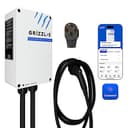 Grizzl-E Classic Connect 40A Grizzl-E's cast-aluminum build with a WiFi radio in it. You get the IP67 body and the cold-flexible 25 ft cable that made the brand's name, plus scheduling, usage history and utility demand-response programs in the Grizzl-E Connect app — in a plug-in unit that comes off the wall when you move. The amperage is still set with a DIP switch, which is either charmingly honest or annoyingly analog depending on your taste. | Remote lockout, in a cast-aluminum body | $349.99 · View on Amazon Price as of October 18, 2026. #ad How we’re funded |
| 2 | 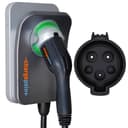 ChargePoint Home Flex The safest default for most homes: you set the amperage in the app to 16, 24, 32, 40, 48 or 50A, so one charger fits whatever circuit your panel can spare today and scales up if you upgrade later. The app is the most mature here, firmware arrives over the air, and the warranty is long. | The most mature app of the group | $516.71 · View on Amazon Price as of October 18, 2026. #ad How we’re funded |
| 3 | 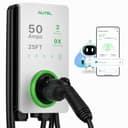 Autel MaxiCharger Home Built for the harshest driveway. The NEMA 4X enclosure is rated to keep charging in extreme cold and heat, it pushes a full 50 amps, and the app is capable. If your charger lives fully exposed to the weather, this is the one. | App control plus an Ethernet port | |
| 4 | 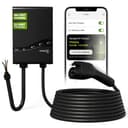 Emporia Pro The answer to a panel that says no. The Pro ships with Emporia's Vue 3 energy monitor in the same box, watches what the rest of the house is drawing, and throttles the car in real time so the total never exceeds what the service can carry — which is how a 48-amp charger ends up on a panel that a load calculation says has no room for one. You pay roughly Home Flex money for it, and only the load management justifies that. | App control with energy monitoring | $599.00 · View on Amazon Price as of October 18, 2026. #ad How we’re funded |
And if none of that applies — if the car is in a closed garage and nobody but you can reach it — then lockout is a feature you are paying for and will never use, and a charger with nothing to log into is the better buy. That is the honest end of this page: unplugging mid-charge is safe for everybody, and the only people who need to spend money on this question are the ones whose charger a stranger can reach. Our smart-versus-dumb comparison is the place to settle that.
Frequently asked questions
Can you unplug an EV while it is charging?
Yes, and you do not need to stop the session first. The J1772 connector standard includes a dedicated signal line that the car and the charger use to negotiate the session continuously, and the connector's latch is wired into it: pressing the release tells the car to shut the current down before the power contacts separate. That sequence happens in a fraction of a second, well before anything mechanical moves apart. Unplugging mid-charge is a normal, designed operation, not an emergency one.
Will unplugging mid-charge damage the car or the charger?
Not in normal operation. The whole point of the control-pilot signalling in the connector standard is that current is never flowing across contacts that are being pulled apart -- the car drops the load first. That is also why a home charger is not really a charger: it is a switched, protected supply, and the actual AC-to-DC conversion happens inside the car, which is where the session is controlled from. Our AC-versus-DC guide covers that distinction.
Why won't my EV let me unplug it?
Almost always because the car has locked the connector on purpose, and that is a feature. Many EVs latch the plug while the car is locked or while a charge session is active, so it cannot be removed by someone walking past. The fix is to unlock the car -- with the key, the app or the door handle -- and then release the latch. If it still will not come out, check whether a charge timer is running or a scheduled session is active, and consult the owner manual, which is the authority on your specific car's locking behaviour.
Can someone else unplug my EV while it is charging?
On an open driveway, physically yes, unless the car is locking the connector. Two layers protect you. The car's own connector lock is the first and is free. The second is a charger that can be locked out in software -- several units in our registry publish remote lockout or access control in their apps, so the charger will not deliver current to anyone who is not authorised. If you charge on an unfenced driveway or share a parking area, that feature is worth paying for, and it is one of the few genuinely useful things a smart charger does.
Should I stop the charge in the app before unplugging?
You do not have to. It is a harmless habit and some owners prefer the tidiness of a clean session record in the charger's app, but the connector handles the electrical side on its own. The one situation where ending the session deliberately is worth it is public DC fast charging, where the rules of the specific network -- idle fees, session billing -- may make the sequence matter. At home on Level 2, squeeze the latch and pull.
Is it bad for the battery to stop a charge part-way?
No. A partial charge is not a wasted or damaging cycle; the car simply resumes next time it is plugged in. If anything, the state of charge you leave the pack at is the variable worth caring about, and your automaker's owner manual is the authority on the daily limit it recommends. We also wrote a page on the broader worry behind this question -- whether Level 2 charging itself is hard on the pack -- and the short version is that it is not.
Sources
- SAE International — J1772 Conductive Charge Coupler — The SAE J1772 connector standard for AC Level 1 and Level 2 charging in North America (accessed July 19, 2026)
- SAE International — J3400 North American Charging System (NACS) — The SAE J3400 / NACS standard (the Tesla-derived connector) now being adopted industry-wide (accessed July 19, 2026)
- U.S. DOE Alternative Fuels Data Center — Electric Vehicles for Consumers — US DOE on connector types: J1772 for Level 1/2, and CCS, CHAdeMO or NACS (J3400) for DC fast charging (accessed July 19, 2026)
- U.S. DOE Alternative Fuels Data Center — Electric Vehicle Charging Stations — US DOE on charging levels: Level 1 (~1.9 kW, ~5 mi/hr), Level 2 (2.9-19.2 kW, ~7.2 kW typical residential, ~25 mi/hr), and DC fast charging (accessed July 19, 2026)
- UL Solutions — EV Charging Infrastructure Services — UL on EVSE safety certification: ANSI/UL 2594 is the Standard for Electric Vehicle Supply Equipment (accessed July 19, 2026)
- U.S. DOE Alternative Fuels Data Center — Maintenance and Safety of Electric Vehicles — The DOE's own page on EV battery longevity, and the one that declines to overclaim. Read in full: 'Like the engines in conventional vehicles, the advanced batteries in electric vehicles (EVs) are designed for extended life but will wear out eventually. While comprehensive data on EV battery failures is not available, many manufacturers offer 8-year/100,000-mile warranties for their EV batteries.' On cycle life: the batteries used in these vehicles 'have a limited number of charging cycles (the number of times the battery can be charged and discharged, also called cycle life)', and the page tells owners to 'Check with the dealer about battery life and warranties'. On maintenance: 'The battery, motor, and associated electronics require little to no regular maintenance', though 'Some automotive battery systems use liquid coolant to maintain safe operating temperatures. These systems may require regular checks.' On replacement: 'Manufacturers typically do not publish pricing for replacement batteries, but if the battery does need to be replaced outside the warranty, it is expected to be a significant expense.' Note what is NOT on this page: the DOE does not name Level 1, Level 2 or DC fast charging as a factor in battery life anywhere on it, and publishes no guidance that home AC charging shortens pack life (accessed October 17, 2026)
- United Chargers — Grizzl-E Classic Connect 40A product overview — Grizzl-E's own overview for the Classic Connect: 'the Wi-Fi Connected Smart Level 2 EVSE for home use' at 40A / 9.6 kW, shipping with the Grizzl-E Connect app for charging statistics, schedules, Demand/Response utility programs, remote control, lockout to prevent unauthorized use, updates and diagnostics; a UL Type 4 water-resistant cast aluminum enclosure with IP67 sealing, a NEMA 14-50 input cable and a 25 ft output cable with a J1772 or NACS connector, 'UL Tested and Certified' with built-in GFCI, over-current, over-voltage, ground-fault and over-temperature protections, and adjustable maximum current set with DIP switches at 40A / 32A / 24A / 16A for a 50A / 40A / 30A / 20A breaker. No ENERGY STAR certification and no OCPP support are published for this model (accessed September 3, 2026)
- ChargePoint — Home Flex datasheet (PDF) — ChargePoint's own datasheet: enclosure rating Type 3R per UL 50E, operating temperature -22F to 122F, 23 ft cable, plus installer notes that an outdoor plug-in install requires an outdoor-rated GFCI breaker upstream while an external GFCI may conflict with the charger's internal ground-fault protection on a hardwired install. RE-READ September 3, 2026 for the review refresh: the same datasheet also publishes maximum 12 kW (240V AC x 50A) with output amperage adjustable via the mobile app to 16A, 24A, 32A, 40A, 48A or 50A; a required dedicated dual-pole breaker rated for 125% of maximum load; 'Software Updates: Firmware updated over-the-air (OTA)'; 2.4/5 GHz Wi-Fi (802.11 a/b/g/n); local storage of up to 90 days of charging session data (100 sessions) if the network drops; power measurement accuracy +/- 2.0%; ground-fault detection by 20 mA CCID with auto retry; and UL and cUL listing per UL 2594, UL 2231-1 and UL 2231-2, NEC Article 625 compliant. Ordering information lists the plug-in station models CPH50-NEMA6-50-L23 and CPH50-NEMA14-50-L23 (accessed September 3, 2026)
- Autel Energy — MaxiCharger AC Elite Home 50A product page — Autel's own listing: compliant with NEMA 4X standards, operating temperature -40F to 131F, 25 ft cable, 3-year warranty. RE-READ October 10, 2026 for the Emporia head-to-head, and the page now publishes materially more: 'Maximum Output | 12 kW / 50 A' with output 'Adjustable 16-50 A'; installation given as 'Hardwired - 70 A Circuit for Full Output'; an 'SAE J1772' connector; an enclosure rating of 'IP65 / NEMA 4X'; an operating range of '-40 to 131 F (-40 to 55 C)'; a '3 Years' warranty quoted as a single term with no component split; 'CSA and ENERGY STAR compliance' (no UL listing is claimed on this page); connectivity listed as 'Bluetooth, Wi-Fi, Ethernet, CAN, RS485'; app control to start, stop and schedule charging, monitor activity and adjust current; dimensions of 13.2 x 7.4 x 3.8 in (336 x 187 x 97 mm) and a weight of 15.4 lbs (7 kg); and the load-management sentence this comparison turns on - 'Supports both Adaptive Load Management (ALM) and charger-to-charger Dynamic Load Balancing (DLB). ALM requires compatible additional hardware, while DLB works between chargers without additional hardware.' The page publishes no solar-specific feature (accessed October 10, 2026)
Keep reading
What happens when you plug in
The same handshake, read from the other direction -- the negotiation that happens before any current flows at all.
Read the guideLeaving it plugged in
The companion question. What the car controls, what the charger controls, and when a timer earns its keep.
Read the guideWhen other people can reach your charger
Where lockout stops being a nice-to-have. The picks for a charger strangers can get to.
See the picksLevel 2 and battery health
The worry underneath a lot of charging questions, answered with the DOE's own published position.
Read the guide