Can You Take Your EV Charger When You Move?
Usually yes - but the charger was never the expensive part. What you paid for was a 240-volt circuit, and that stays in the wall. Whether taking the box with you is worth doing comes down to which install type you chose, and what the next house already has.
How this is funded: we earn a commission if you buy through our links, at no extra cost to you. It never changes which product we recommend, and we’ll tell you when we’d skip one. Full disclosure.
If your charger plugs in, take it — that is what plug-in installs are for. If it is hardwired, it can still travel, but you are paying an electrician at both ends and leaving a live circuit behind that has to be made safe. Either way, the thing to be clear-eyed about is that the box on the wall is the cheap half of what you bought. The expensive half was the 240-volt circuit, and that is part of the house now.
This is one of the quieter arguments in the hardwired-versus-plug-in decision, and it rarely gets weighed at purchase time because nobody buying a charger is thinking about their next house. It is worth a few minutes now if you are still choosing.
Work out which kind you have
Look at how the unit meets the wall. A cord leaving the bottom of the enclosure and ending in a chunky four-pin plug is a NEMA 14-50 (or a three-pin 6-50) and it unplugs. Conduit or armoured cable entering the enclosure directly, with no plug anywhere, means hardwired.
Some units are sold both ways, which is where people get confused about their own charger. Emporia lists installation as “NEMA Plug or Hardwire” for the same product. ChargePoint sells the Home Flex hardwired, on a NEMA 6-50 or on a NEMA 14-50. Grizzl-E publishes “multiple plug-in configurations of NEMA 14-50 or NEMA 6-50 and hardwire ready.” So the brand on the box does not tell you; your own install does.
A few are one way only. Lectron’s Nexus 48A is hardwire-only by its own product page, as is the EVIQO 48A. If that is what you have, the decision below is a real one rather than a formality.
The plug-in case: genuinely easy
Unplug it, take the bracket off the wall, box it with the manual, done. No electrician, no permit, no dispute about fixtures. This is exactly the benefit our plug-in roundup is built around, and it is the main reason we point renters at plug-in and portable units in the renters roundup.
Two things to do on the way out. Leave the receptacle — it is part of the house wiring and it stays. And tell the next occupant what it is, because a 14-50 where the car parks is a selling point if the buyer knows what they are looking at and an unexplained oddity if they do not.
The hardwired case: what it actually costs
A hardwired charger is wired into the circuit, so removing it is electrical work at both ends. Three costs, and the third is the one people miss.
Disconnection. An electrician isolates the circuit, disconnects the unit and removes it. Short visit, but a visit.
Making the old circuit safe.You are leaving a live 240-volt circuit terminating in nothing. It cannot be left capped behind a hole in the drywall. The two normal outcomes are a properly blanked junction box or a receptacle fitted in its place — and the second is worth paying for, because it converts the circuit into something a buyer can plug a charger into. A 14-50 in the garage is a feature; a blanked box where the charger used to be is a question you will be asked at the inspection.
Reinstallation.Another electrician at the new house, assuming there is a circuit to connect to. If there is not, you are paying for the full install — panel work, the run, conduit, permit, inspection — which is most of what you spent the first time. Our install cost breakdown and state-by-state costs are the places to sanity-check that against the price of simply buying a new charger at the other end.
That is the calculation in one line: if the new house has no 240-volt circuit where the car parks, moving a hardwired charger saves you the price of the charger and nothing else. Sometimes leaving it with the property and buying fresh is both simpler and better value — and it makes your house the one on the street with EV charging already in.
What to check about the new place first
Is there a circuit where the car will park? Ask the question directly, and ask what receptacle is on it. A 14-50 in a garage is common in houses built or renovated recently. A 6-50 near a workbench is often a welder outlet and may be on a circuit that suits you.
Does it have the amperage you need?This is where a fixed-output charger can bite. Because the NEC treats EV charging as a continuous load and sizes the circuit at 125%, a 48-amp charger needs a 60-amp circuit — no smaller. An adjustable charger can be dialled down to fit what the new panel can spare: ChargePoint’s datasheet lists app-selectable output at 16, 24, 32, 40, 48 or 50 amps, EVIQO publishes app-adjustable 6 to 40 amps, and the Grizzl-E units set 40, 32, 24 or 16 amps on a DIP switch. A hardwire-only unit with one fixed output has no such flexibility. Check panel capacity at the new address before assuming, and see our small-panel picks if the answer is tight.
Is the mounting point outdoors? A charger that lived in a garage may be going onto an exposed wall, and the enclosure rating you have now may not suit. Our no-garage guide and what an outdoor rating covers apply.
Paperwork, warranty and permission
Warranties attach to the unit and generally run from purchase, so a charger that moves keeps its remaining term — three years is the common figure across the brands we track. You need the receipt to use it, so keep it with the manual, and keep the install documentation too: the next electrician will want the amperage setting and the circuit requirement without having to work them out.
If you are leaving a rental, tell the landlord before you take anything off the wall, especially if the install was done with their permission and particularly if it was hardwired. And if you are selling, put what stays and what goes in writing before contracts. The dispute is never about the charger’s value — it is about a buyer who was told the house had EV charging.
Chargers that travel well
If you expect to move within a few years, buy for it. A plug-in unit comes off the wall, and an adjustable one fits whatever circuit the next house can spare.
| Spec | EVIQO 40A NEMA 14-50 Charger | ChargePoint Home Flex | Grizzl-E Classic Connect 40A | Ampure Go Portable Level 2 Charger |
|---|---|---|---|---|
| Install | NEMA 14-50 plug | Hardwired, NEMA 6-50 or NEMA 14-50 | NEMA 14-50 plug | NEMA 14-50 cord for 240V, NEMA 5-15 cord for 120V |
| Max output | 40 A | 50 A | 40 A | 32 A |
| Circuit at 125% | 50 A | 70 A | 50 A | 40 A |
| Cable length | 25 ft | 23 ft | 25 ft | 20 ft |
| Warranty | 3 years | 3 years | 3 years | 3 years |
Quick picks
Ranked on published specs, charging speed, electrical fit and value. Select a row to jump to the full write-up. We have not bench-tested these chargers — here is exactly what we do instead.
| # | Product | Best for | Price |
|---|---|---|---|
| 1 | 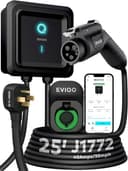 EVIQO 40A NEMA 14-50 Charger The most charger you can get without an electrician's invoice. It plugs into a NEMA 14-50 outlet for a full 40 amps, keeps the WiFi app, the ENERGY STAR listing and the 25 ft cable from EVIQO's hardwired unit, and can be unplugged and taken with you when you move. | Plug-in 40A, app-adjustable 6-40A | |
| 2 | 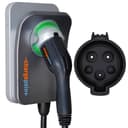 ChargePoint Home Flex The safest default for most homes: you set the amperage in the app to 16, 24, 32, 40, 48 or 50A, so one charger fits whatever circuit your panel can spare today and scales up if you upgrade later. The app is the most mature here, firmware arrives over the air, and the warranty is long. | Plug-in option and 16-50A in the app | $516.71 · View on Amazon Price as of October 17, 2026. #ad How we’re funded |
| 3 | 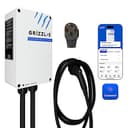 Grizzl-E Classic Connect 40A Grizzl-E's cast-aluminum build with a WiFi radio in it. You get the IP67 body and the cold-flexible 25 ft cable that made the brand's name, plus scheduling, usage history and utility demand-response programs in the Grizzl-E Connect app — in a plug-in unit that comes off the wall when you move. The amperage is still set with a DIP switch, which is either charmingly honest or annoyingly analog depending on your taste. | Plug-in with DIP-switch amperage | $349.99 · View on Amazon Price as of October 17, 2026. #ad How we’re funded |
| 4 | 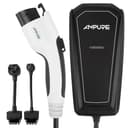 Ampure Go Portable Level 2 Charger The only portable charger we track that is certified like a permanent one. UL 2594 / UL 2231, ENERGY STAR and an IP67 / NEMA 6P body rated from -22F to 122F, in a nine-pound module that ships with a NEMA 14-50 cord for 240V and a standard 5-15 cord for 120V. You give up eight amps against the 40A units and get, in exchange, a charger genuinely rated to live in a trunk and be rained on. | Fully portable, 240V and 120V cords | $299.00 · View on Amazon Price as of October 17, 2026. #ad How we’re funded |
Frequently asked questions
Can I take my EV charger with me when I move house?
If it is plug-in, yes - unplug it, unbolt the bracket and it comes with you, which is the main reason plug-in installs exist. If it is hardwired, physically yes but you need an electrician to disconnect it and make the circuit safe, and another at the new house to install it. The charger moves easily; the 240-volt circuit you paid for does not move at all.
Does the EV charger stay with the house when you sell?
That is a negotiation, not a rule, and it needs to be in writing. The circuit and receptacle are part of the property's wiring and stay regardless. Whether the charger itself is a fixture depends on how it is installed and what your contract says - a hardwired unit reads much more like a fixture than a plug-in one does, and buyers who were told the house has EV charging will expect it to still be there.
What happens to the wiring if I take a hardwired charger?
It has to be made safe by an electrician. You are left with a live 240-volt circuit terminating in nothing, which cannot simply be left capped behind the box you removed. The two normal outcomes are a properly blanked junction box or a receptacle fitted in its place - and the second option is worth considering, because it turns the circuit into something the next owner can plug a charger into.
Is it worth taking an EV charger to a rental?
Only a plug-in or portable one, and only with the landlord's agreement. The value of a portable unit in a rental is precisely that it needs no permission and leaves with you - the Ampure Go, for instance, publishes both a NEMA 14-50 and a NEMA 5-15 cord, so it works from a standard household outlet if there is no 240-volt supply at all.
Will my charger work at the new house?
Electrically, almost certainly - these are 208 to 240 volt devices and that is what US homes supply. The two things to check are whether a circuit exists where the car will park and whether it has enough amperage: a 48-amp charger needs a 60-amp circuit because the NEC sizes continuous loads at 125%. If the new panel can only spare 50 amps, an adjustable charger can be dialled down, while a fixed-output one cannot.
Sources
- NFPA — Using the Latest NEC for EV Charger Installations — NFPA on NEC (NFPA 70) Article 625: EV charging is a continuous load, so circuits are sized to 125% of load (the 80% rule) (accessed July 19, 2026)
- ChargePoint — Home Flex home charger product page — ChargePoint's own current product page for the Home Flex, read for the 2026-09-03 review refresh: three install configurations are offered — hardwired, NEMA 6-50 plug and NEMA 14-50 plug — with 'up to 50 amps of power delivered to your EV' on the hardwired model and 'up to 40A of power' on the plug-in models. ChargePoint's own range claim is 'up to 37 miles of range per hour' hardwired and '30 miles of range per hour' plug-in. J1772 and NACS connectors are offered across all configurations, and ChargePoint states the unit is 'UL Listed for safety', 'ENERGY STAR certified for efficiency' and carries a '3-year warranty' (accessed September 3, 2026)
- ChargePoint — Home Flex datasheet (PDF) — ChargePoint's own datasheet: enclosure rating Type 3R per UL 50E, operating temperature -22F to 122F, 23 ft cable, plus installer notes that an outdoor plug-in install requires an outdoor-rated GFCI breaker upstream while an external GFCI may conflict with the charger's internal ground-fault protection on a hardwired install. RE-READ September 3, 2026 for the review refresh: the same datasheet also publishes maximum 12 kW (240V AC x 50A) with output amperage adjustable via the mobile app to 16A, 24A, 32A, 40A, 48A or 50A; a required dedicated dual-pole breaker rated for 125% of maximum load; 'Software Updates: Firmware updated over-the-air (OTA)'; 2.4/5 GHz Wi-Fi (802.11 a/b/g/n); local storage of up to 90 days of charging session data (100 sessions) if the network drops; power measurement accuracy +/- 2.0%; ground-fault detection by 20 mA CCID with auto retry; and UL and cUL listing per UL 2594, UL 2231-1 and UL 2231-2, NEC Article 625 compliant. Ordering information lists the plug-in station models CPH50-NEMA6-50-L23 and CPH50-NEMA14-50-L23 (accessed September 3, 2026)
- Emporia - EV Chargers (Classic vs Pro) — Emporia's own Classic-vs-Pro comparison page: both units publish a 25 ft cable, 'NEMA Plug or Hardwire' installation, 'Up to 48A' and a 3-year warranty. The feature rows list Smart Scheduling, Home Energy Monitoring, Solar Charging Integration, Peak Demand Management and PowerSmart Load Management, footnoted for the Classic as 'Requires Vue Home Energy Monitor' and for the Pro as 'Requires Vue Home Energy Monitor and PowerSmart upgrade'. The Classic section states 'Add the Vue Home Energy Monitor and we'll manage Peak Demand and automatically charge with your excess solar power', and Emporia's platform lists 'Excess Solar Management' as a named feature. The page also states 'PowerSmart comes standard with the Emporia Pro, but can be added to the Emporia Classic for an extra cost'. Emporia's own listed prices on the date accessed are not reprinted here. RE-READ October 17, 2026 for the smart-home roundup: every figure above is unchanged, the page additionally publishes 'Intelligent Load Sharing' for multiple chargers on one circuit and an in-app assistant ('Ask questions about your energy usage and get instant answers'), and it names NO third-party or smart-home integration of any kind - no Alexa, Google Home, Apple Home / HomeKit, Matter, Home Assistant, IFTTT, OCPP or public API appears anywhere on it (accessed October 17, 2026)
- Emporia - Classic Level 2 EV Charger (store listing) — Emporia's own store listing for the Classic: 'Need advanced features like home energy monitoring, solar charging, or PowerSmart Load Management? Check out the Emporia Pro EV Charger', and 'PowerSmart can also be added to the Classic charger for an additional cost if your electrical panel doesn't have enough capacity for a Level 2 charger'. The listing's install notes describe continuous Level 2 charging as 'a fundamentally different demand than the dryers and ranges most NEMA 14-50 outlets were designed for' (accessed September 17, 2026)
- United Chargers — Grizzl-E Classic product overview — Grizzl-E's own overview for the Classic: 'built with a sturdy, water-resistant cast aluminum enclosure and comes with a 25ft output cable that remains flexible in cold temperatures', an aluminum IP67 enclosure rated from -22F, an 18-inch input cable with either a NEMA 14-50 or a NEMA 6-50 plug, adjustable maximum output current of 40, 32, 24 or 16 amps, and 'multiple plug-in configurations of NEMA 14-50 or NEMA 6-50 and hardwire ready' (accessed September 3, 2026)
- Ampure - Ampure Go portable Level 2 EV charger product page — Ampure's own specifications for the Go: 32 A / 7.7 kW at 240 V or 12 A / 1.4 kW at 120 V, input range 85-265 VAC at 45-65 Hz, SAE J1772 coupler, NEMA 14-50 and NEMA 5-15 cords, 20 ft (6 m) cable, IP67 rated 'submersible up to 3 feet' with a NEMA 6P watertight enclosure, operating range -30C to +50C (-22F to 122F), 9 lb (4.1 kg) module, and listings to UL, cUL, UL 2594, UL 2231, UL 817, ICES, FCC, ENERGY STAR, REACH and RoHS. Ampure states 'up to 25 miles of range per hour' at 240 V. RE-READ October 10, 2026 for the review: every figure above is unchanged on the page. Confirmed again that this page publishes NO warranty term (that figure is on the store listing), NO app, WiFi or scheduling feature, and NO description of the unit's internal safety protections (no GFCI / CCID figure, no over-temperature behavior). The page describes the unit as an 'IP67-rated IC-CPD', i.e. an in-cable control and protection device, and the specification block gives the plug types as 'NEMA 14-50 & NEMA 5-15' alongside an 'IEC grid plug'. Ampure's current line separates this unit from a distinct 'Go 2 (NACS)' model; the specifications above are the Gen 1 J1772 unit Amazon lists as the 'Go 1' (accessed October 10, 2026)
- EVIQO — Level 2 EV Charger, 40A (9.6 kW), NEMA 14-50 plug-in (Gen 2) — EVIQO's own product page: 40A / 9.6 kW on a NEMA 14-50 plug, SAE J1772, 25 ft charging cable plus a 40 in input cable, IP66 / NEMA 4 enclosure, UL / ETL / FCC / ENERGY STAR listings, 3-year standard warranty, app-adjustable 6-40A output, and a note that it needs an EV-grade 4-prong 14-50 receptacle rather than a dryer outlet. RE-READ September 15, 2026 for the garage roundup: the page additionally states an operating temperature range of -22F to 122F, that the app needs a 2.4 GHz WiFi connection, that the standard 3-year warranty is extendable to 4, and that the unit ships in 1-2 business days (accessed September 15, 2026)
- Lectron — NEXUS Level 2 J1772 EV Charging Station, 240V, 48 Amp, Hardwired — Lectron's own product page: up to 48 A continuous at 240 V for 11.5 kW, hardwire-only install by a licensed electrician on a dedicated 240 V circuit, IP66 weatherproof housing for indoor or outdoor use, 23 ft output cable of 15.0 mm (±0.3 mm) heavy-duty compound the brand states is 'engineered to stay flexible and easy to wrap around the wall mount, even in freezing weather', wall-mount J-hook and plug holder included, ETL listed to UL 2594 / UL 2231 / UL 2251 with ENERGY STAR and FCC certification, and a 3-year Lectron warranty. No operating-temperature range and no Wi-Fi or app support are published for this model (accessed August 20, 2026)
- Lectron - EV Charging FAQ — Lectron's own FAQ, read for its plug-and-cord guidance: 'It's recommended to plug the charger directly into a dedicated outlet without extension cords', with a safety list that reads 'Always match plug and outlet ratings (volts/amps)', 'Use GFCI protection for outdoor plugs', 'Avoid extension cords or daisy-chaining', 'Inspect plugs and cables regularly' and 'Hire a licensed electrician for installation'. Its NEMA table publishes 5-15 as 120V / 15A, 5-20 as 120V / 20A, 6-20 as 240V / 20A, 10-30 / 14-30 as 240V / 30A ('Common in older dryers') and 14-50 as 240V / 50A, and states that Lectron offers NEMA 5-15, 14-50 and 10-30 plug options for portable charging. Also states that a Tesla owner can use the J1772-to-Tesla adapter 'included with most Tesla', and that adapters 'don't generate power - they only enable compatibility between chargers and vehicles' (accessed September 17, 2026)
- U.S. DOE Alternative Fuels Data Center — Charging Electric Vehicles at Home — US DOE on home EV charging: most owners charge overnight on Level 1 or Level 2, installs follow NEC Article 625, with example home-charging costs (accessed July 19, 2026)
Keep reading
Hardwired vs plug-in
The decision this page is downstream of - and the one that decides whether your charger is portable at all.
Read the comparisonBest plug-in chargers
The units that come off the wall: no electrician if the outlet exists, and 40 amps is the ceiling.
See the picksBest chargers for renters
Buying for a home you do not own, where leaving with the charger is the whole point.
See the picksThe NEMA 14-50 outlet
What the next house needs before a plug-in charger is useful - and why an EV-grade receptacle matters.
Read the guide