Are EV Charging Cables Universal?
Close to it, with one real exception. For AC charging at home, two connectors cover the whole US market — J1772 and NACS — and the cable on a home charger is not usually a separate part you can swap at all.
How this is funded: we earn a commission if you buy through our links, at no extra cost to you. It never changes which product we recommend, and we’ll tell you when we’d skip one. Full disclosure.
For AC charging at home in the US, effectively yes — two connectors cover every new car sold. J1772 fits every non-Tesla EV and plug-in hybrid, and fits a Tesla with the adapter Tesla supplies. NACS is the Tesla-native connector, now appearing as the factory port on cars from several other manufacturers. A home charger with either one will charge the overwhelming majority of cars on the road, directly or through the adapter in the trunk.
But there are two things worth knowing before you treat “universal” as the end of the subject. The first is that on a home charger the cable is usually not a separate part at all— every unit in our registry has its cable permanently attached, so there is nothing to swap and the connector is a purchase decision rather than an accessory one. The second is that the adapter story is not symmetrical, and the asymmetry is the single most important thing on this page.
The cable on your charger is not a cable you choose
Every charger we track is tethered: the cable and connector are part of the unit, listed as a whole to the EV-charging standards, and rated as a system for the charger’s output. That has three consequences.
You pick the connector when you pick the charger.A J1772 unit stays a J1772 unit. Which is why, if you drive a Tesla or another NACS car, the question is whether to buy a native-NACS charger or use the adapter — covered in our Tesla roundup.
The amperage rating is already handled.A 48-amp charger ships with a cable rated for 48 amps continuous, because the listing covers the whole assembly. You cannot accidentally under-rate it — unless you add something, which is the next point.
Length is a spec, not an upgrade.Our registry runs from 16 to 25 feet, and you are stuck with what you buy. Since charge ports sit on the left front of some cars and the right rear of others, this is a bigger deal than it sounds — see the long-cable roundup and the placement guide. The untethered alternative, where the cable is a separate lead, is largely a European pattern; we cover the trade in the tethered-versus-untethered comparison.
The asymmetry: J1772 to Tesla is fine, NACS to non-Tesla is not automatic
Direction one works. A J1772 home charger plus the adapter Tesla supplies with the car charges a Tesla normally. This is a well-trodden setup and the reason the most popular home chargers in the country are J1772.
Direction two needs reading.If your car has a NACS port but is not a Tesla, do not assume a NACS wall charger is the obvious buy. Two things we have read on automakers’ own pages:
- Volkswagenstates that its approved NACS adapter is “for use with compatible DC chargers only,” instructs owners “Do not use NACS DC adapter with any Level 1 or Level 2 AC chargers, including Tesla Destination chargers and home chargers with NACS connectors,” and treats third-party adapters as at the owner’s own risk. On a VW, our ID.4 roundup recommends J1772 units and argues against the NACS ones by name.
- Kia ships a NACS port on the EV6 and EV9, lists a NACS-to-CCS adapter for DC charging in some states, and lists noJ1772-to-NACS AC adapter anywhere on those pages — while naming a J1772 charger in its own home-charging section. We published that tension rather than resolving it on the EV6 page.
The rule we would follow: match the wall to the car natively where you can, and where you cannot, use the adapter the automaker itself supplies and endorses rather than one bought separately. Our J1772-versus-NACS guide tracks where the transition stands.
The one swap to avoid entirely
Extension cords.This is the accessory we are most consistently negative about, and the reason is the rating logic above. A charger’s listed cable is rated as part of the appliance; a cord you buy is not part of that listing, is a new connection point under a continuous load for hours at a time, and manufacturer instructions generally advise against it. If the cable does not reach, the answer is to move the charger or buy one with a longer cable — not to extend it. Full detail in the extension-cord guide.
The related trap is the wall end rather than the car end. The plug on a plug-in charger has to match a real, dedicated receptacle: a NEMA 14-50 is not a NEMA 14-30, and an old dryer outlet is not an EV circuit no matter what adapter exists for it. See the plug-types guide and the dryer-outlet page.
Picking the connector, not the cable
Since the cable is fixed, what you are really choosing is the connector and the reach. Four units that make that choice cleanly:
Quick picks
Ranked on published specs, charging speed, electrical fit and value. Select a row to jump to the full write-up. We have not bench-tested these chargers — here is exactly what we do instead.
| # | Product | Best for | Price |
|---|---|---|---|
| 1 | 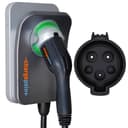 ChargePoint Home Flex The safest default for most homes: you set the amperage in the app to 16, 24, 32, 40, 48 or 50A, so one charger fits whatever circuit your panel can spare today and scales up if you upgrade later. The app is the most mature here, firmware arrives over the air, and the warranty is long. | J1772, 23 ft, fits any circuit | $516.71 · View on Amazon Price as of October 18, 2026. #ad How we’re funded |
| 2 | 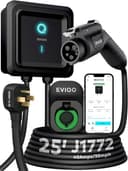 EVIQO 40A NEMA 14-50 Charger The most charger you can get without an electrician's invoice. It plugs into a NEMA 14-50 outlet for a full 40 amps, keeps the WiFi app, the ENERGY STAR listing and the 25 ft cable from EVIQO's hardwired unit, and can be unplugged and taken with you when you move. | J1772, 25 ft plus a 40 in input lead | |
| 3 | 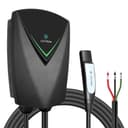 Lectron Nexus NACS (Tesla) Charger For a Tesla owner who doesn't want to babysit an adapter: a native NACS (J3400) connector plugs straight into the car, at a full 48 amps, with the safety listings you want. No app, but Teslas schedule charging in the car anyway. | Native NACS, no adapter at home | $449.99 · View on Amazon Price as of October 18, 2026. #ad How we’re funded |
| 4 | 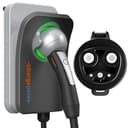 ChargePoint Home Flex NACS The Home Flex smarts with a factory NACS cable. Tesla owners who want ChargePoint's mature app and adjustable 16-50A amperage — rather than a plain no-app NACS unit — pay a premium for exactly that. | Native NACS with the full app | $516.71 · View on Amazon Price as of October 18, 2026. #ad How we’re funded |
If you drive a non-Tesla EV, take a J1772 unit and stop thinking about it. If you drive a Tesla, either works — native NACS removes an adapter from the equation, which in a wet driveway is a small but real daily improvement. And if you drive a non-Tesla car with a NACS port, read your own manual before buying a NACS charger, because that is the one case where the market is still ahead of the documentation. Our brands page covers who sells which connector, and the reviews have the full spec table for each.
Frequently asked questions
Are EV charging cables universal?
For AC home charging in the US, almost. Two connectors cover every new car sold: J1772, which fits every non-Tesla EV and plug-in hybrid, and NACS, the Tesla-native connector now appearing on cars from several other makers. A J1772 charger will charge a Tesla using the adapter Tesla supplies with the car. The real catch runs the other way: a NACS home charger plugged into a non-Tesla NACS car through a third-party AC adapter is the one combination to be careful about, because at least one automaker explicitly warns against it in writing.
Can I use any charging cable with my EV?
On a home charger, the question is usually moot: on every unit in our registry the cable is permanently attached -- what the industry calls tethered -- so there is nothing to swap. It is the charger that has to match your car's port, not a cable you buy separately. Where a loose cable does exist is at public AC charging posts in some markets, and for those the cable has to match both the post and the car as well as being rated for the current the post can supply.
Does a J1772 charger work with a Tesla?
Yes. Teslas sold in North America come with a J1772 adapter, and with it a J1772 home charger charges the car normally. Plenty of Tesla owners run exactly this setup, and our Tesla roundup covers it. The alternative is a charger with a native NACS connector so nothing hangs off the car -- Lectron and ChargePoint both sell one. Neither route is faster than the other; the difference is one less adapter to lose and one less joint to sit in the rain.
Can I use a NACS home charger on a non-Tesla EV?
Check your automaker's own guidance first, because this is the one place the universality story breaks down. Volkswagen states in writing that its NACS adapter is 'for use with compatible DC chargers only' and should not be used 'with any Level 1 or Level 2 AC chargers, including Tesla Destination chargers and home chargers with NACS connectors', treating third-party adapters as at the owner's own risk. Kia, meanwhile, ships NACS ports on the EV6 and EV9 and lists no J1772-to-NACS AC adapter anywhere on its own pages, while naming a J1772 charger in its home-charging section. If your car has a NACS port, read the manual before buying a NACS wall unit.
Does the cable's amperage rating matter?
Yes, and on a home charger it is already handled for you -- the cable is part of a unit listed as a whole to the EV-charging standards, so a 48-amp charger ships with a cable rated for 48 amps. Where rating becomes your problem is anything you add: an extension cord, which manufacturers generally advise against for this exact reason, or an adapter between plug types. Our extension-cord guide covers why that is the accessory we are most consistently negative about.
Is a longer charging cable better?
Up to a point, and it is the most underrated spec on a charger. Cable length decides where the unit can be mounted and whether it reaches your car's charge port without crossing a walkway -- and charge ports are on the left front of some cars and the right rear of others. The chargers we track run from 16 to 25 feet. The trade with a long cable is weight and somewhere to put it, which is why a holster matters. Our long-cable roundup ranks on exactly this.
Sources
- SAE International — J1772 Conductive Charge Coupler — The SAE J1772 connector standard for AC Level 1 and Level 2 charging in North America (accessed July 19, 2026)
- SAE International — J3400 North American Charging System (NACS) — The SAE J3400 / NACS standard (the Tesla-derived connector) now being adopted industry-wide (accessed July 19, 2026)
- U.S. DOE Alternative Fuels Data Center — Electric Vehicles for Consumers — US DOE on connector types: J1772 for Level 1/2, and CCS, CHAdeMO or NACS (J3400) for DC fast charging (accessed July 19, 2026)
- U.S. DOE Alternative Fuels Data Center — Electric Vehicle Charging Stations — US DOE on charging levels: Level 1 (~1.9 kW, ~5 mi/hr), Level 2 (2.9-19.2 kW, ~7.2 kW typical residential, ~25 mi/hr), and DC fast charging (accessed July 19, 2026)
- Volkswagen - 2026 ID.4 (official US model page, charging content slider + FAQs + disclaimers) — Volkswagen's own US ID.4 page. The decisive figure is in disclaimer DIS_0321, attached to the home-charging FAQ answer: 'Vehicle maximum AC acceptance rate is 11kW. Charging times will vary and depend on a variety of factors, including ambient temperature, kW, charging rate of home charger, battery condition and initial state of charge, vehicle condition and others.' The FAQ itself reads: 'In optimal conditions, using DC fast charging, the 2026 Volkswagen ID.4 can charge from 10% to 80% battery in approximately 28 minutes... With home charging, and at up to 11 kW with the available home wall charger, the 2026 Volkswagen all-electric ID.4 EV typically takes up to 8 hours to go from a completely empty battery to a full charge.' The 'At-Home Charging' panel of the charging content slider states: 'We make charging your 2026 ID.4 at home simple with the included 2-in-1 EV Charge Cable, capable of charging from standard 120v household outlets (approx. 1.2kW for about 3 miles per hour), or 240v outlets for quicker charging (approx. 9.6kW for up to 27 miles per hour)', and points owners at Qmerit for installation pricing. Disclaimer 18, attached to the Tesla Supercharger panel, is the other load-bearing line: 'Volkswagen approved NACS DC adapter is sold separately. NACS DC adapter is for use with compatible DC chargers only, including Tesla Superchargers identified by Tesla as an “NACS Partner Site.” ... Do not use NACS DC adapter with any Level 1 or Level 2 AC chargers, including Tesla Destination chargers and home chargers with NACS connectors. The use of any third-party adapters is at your own risk.' EPA-estimated range by trim, from VW's own FAQ: ID.4 Pro 291 miles, Pro S 291, AWD Pro 263, AWD Pro S 263, AWD Pro S Plus 263. The page also lists a 2-year Electrify America Pass+ membership with Plug&Charge. Volkswagen does NOT name the AC connector type (J1772 is never written), does NOT publish the battery's kWh capacity, and does NOT publish a maximum onboard-charger amperage - so the ~46 A figure on our page is our own arithmetic from VW's 11 kW at 240 V, and the 11 kW miles-per-hour figure is ours, scaled from VW's own 9.6 kW / 27 mi-per-hour pair. Vehicle pricing shown on the page is not reprinted here (accessed October 3, 2026)
- Kia - 2026 EV6 Features & Specifications (official specs-compare page) — Kia's own EV6 specification tables, read across the 2026 trims (Light, Light Long Range, Wind, GT-Line). 'Onboard Charger Power' reads '10.9 kW' on EVERY trim. 'Drive Battery Energy' is 63.0 kWh on Light and 84.0 kWh on Light Long Range, Wind and GT-Line. A 'North American Charging System (NACS)' port and a 'Dual Level 120V / 240V Portable Charging Cable' are standard across the line; a 'NACS to CCS Adapter' is listed as available in ZEV States only, and no J1772-to-NACS AC adapter is listed anywhere on the page. Charge times: the Level 2 row, labeled '@ 240V / 11kw via Electric Vehicle Supply Equipment', reads 'Approx. 5 hrs. and 40 min.' on the 63.0 kWh battery and 'Approx. 7 hrs. 20 min.' on the 84.0 kWh battery, while the 120V in-cable-control-box row reads 'Approx. 54 hrs. and 5 min.' and 'Approx. 72 hrs.' respectively. DC fast charging: approx. 20 min. at 350 kW on every trim, approx. 24 / 29 min. at 150 kW and approx. 61 / 81 min. at 50 kW. EPA-estimated range is 237 miles (Light) and 319 miles (Light Long Range, Wind, GT-Line). V2L is listed as standard on Wind and GT-Line and not available on the Light trims. Note the internal mismatch we publish rather than resolve: the onboard charger is rated 10.9 kW while Kia's own Level 2 charge-time row is labeled 11 kW. Kia does NOT publish a maximum onboard-charger amperage, so the ~45 A figure on our page is our own arithmetic from 10.9 kW at 240 V, and the miles-per-hour figures are ours from Kia's own range-and-battery pairs (accessed October 10, 2026)
- UL Solutions — EV Charging Infrastructure Services — UL on EVSE safety certification: ANSI/UL 2594 is the Standard for Electric Vehicle Supply Equipment (accessed July 19, 2026)
- ChargePoint — Home Flex datasheet (PDF) — ChargePoint's own datasheet: enclosure rating Type 3R per UL 50E, operating temperature -22F to 122F, 23 ft cable, plus installer notes that an outdoor plug-in install requires an outdoor-rated GFCI breaker upstream while an external GFCI may conflict with the charger's internal ground-fault protection on a hardwired install. RE-READ September 3, 2026 for the review refresh: the same datasheet also publishes maximum 12 kW (240V AC x 50A) with output amperage adjustable via the mobile app to 16A, 24A, 32A, 40A, 48A or 50A; a required dedicated dual-pole breaker rated for 125% of maximum load; 'Software Updates: Firmware updated over-the-air (OTA)'; 2.4/5 GHz Wi-Fi (802.11 a/b/g/n); local storage of up to 90 days of charging session data (100 sessions) if the network drops; power measurement accuracy +/- 2.0%; ground-fault detection by 20 mA CCID with auto retry; and UL and cUL listing per UL 2594, UL 2231-1 and UL 2231-2, NEC Article 625 compliant. Ordering information lists the plug-in station models CPH50-NEMA6-50-L23 and CPH50-NEMA14-50-L23 (accessed September 3, 2026)
- Lectron — NEXUS Level 2 J1772 EV Charging Station, 240V, 48 Amp, Hardwired — Lectron's own product page: up to 48 A continuous at 240 V for 11.5 kW, hardwire-only install by a licensed electrician on a dedicated 240 V circuit, IP66 weatherproof housing for indoor or outdoor use, 23 ft output cable of 15.0 mm (±0.3 mm) heavy-duty compound the brand states is 'engineered to stay flexible and easy to wrap around the wall mount, even in freezing weather', wall-mount J-hook and plug holder included, ETL listed to UL 2594 / UL 2231 / UL 2251 with ENERGY STAR and FCC certification, and a 3-year Lectron warranty. No operating-temperature range and no Wi-Fi or app support are published for this model (accessed August 20, 2026)
- EVIQO — Level 2 EV Charger, 40A (9.6 kW), NEMA 14-50 plug-in (Gen 2) — EVIQO's own product page: 40A / 9.6 kW on a NEMA 14-50 plug, SAE J1772, 25 ft charging cable plus a 40 in input cable, IP66 / NEMA 4 enclosure, UL / ETL / FCC / ENERGY STAR listings, 3-year standard warranty, app-adjustable 6-40A output, and a note that it needs an EV-grade 4-prong 14-50 receptacle rather than a dryer outlet. RE-READ September 15, 2026 for the garage roundup: the page additionally states an operating temperature range of -22F to 122F, that the app needs a 2.4 GHz WiFi connection, that the standard 3-year warranty is extendable to 4, and that the unit ships in 1-2 business days (accessed September 15, 2026)
Keep reading
J1772 vs NACS
The two connectors in detail -- what each one is, which cars have which, and where the transition currently stands.
Read the guidePlugs and outlets, both ends
The car-side connector is only half of it. The wall-side plugs -- 14-50, 6-50, 14-30 -- and what each one supports.
Read the guideExtension cords
The accessory we are most negative about, and the published reasons why.
Read the guideBest long-cable chargers
Since the cable is usually not swappable, the reach is a purchase decision. The units with the longest we track.
See the picks