Level Two Club

Best Gifts for the EV Owner Who Has Everything

They have the car, the charger on the wall and opinions about both. A second charger is not the answer — but a charger that solves a specific problem they have been living with is. Here are the four problems worth solving, and the gifts that would sit in a box.

By Stephen V.Last updated How we pick

The EV owner who already has a Level 2 charger is the hardest person on this site to buy for, because the obvious gift is done. A faster charger is rarely an upgrade: nearly every home unit already fills a car overnight, and the car’s own onboard charger caps how fast it can take power regardless of what is on the wall. A second app is a chore. A second cable is a drawer item.

What does land is a charger that solves a problem they have been quietly working around. There are four we can name. A second EV in the household, which turns charging into a nightly negotiation over one plug. An electrical panel that is full, which is why their current charger is smaller than they wanted. A car that can actually accept 80 amps, which is rare and specific. And a driveway that freezes, where the current charger’s cable goes rigid every January. Each pick below answers one of those, and each comes with the question you need to ask to be sure it applies. We own none of these units and have not tested them; specs are the manufacturers’ published figures, and prices are checked daily and dated.

How this is funded: we earn a commission if you buy through our links, at no extra cost to you. It never changes which product we recommend, and we’ll tell you when we’d skip one. Full disclosure.

Quick picks

Ranked on published specs, charging speed, electrical fit and value. Select a row to jump to the full write-up. We have not bench-tested these chargers — here is exactly what we do instead.

#ProductBest forPrice
1
Grizzl-E Duo Connect 40A

Grizzl-E Duo Connect 40A

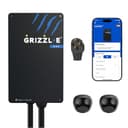
One box, two cables, one circuit. The Duo Connect lets a two-EV household charge both cars overnight without a second charger, a second breaker or a panel upgrade — because it splits one 40-amp supply between the connectors rather than doubling it. That is the whole trade: convenience and a much cheaper install, at half the speed each when both cars are plugged in.

For the household that just got a second EV
$899.99 · View on Amazon

Price as of September 18, 2026. #ad How we’re funded

2
Emporia Pro

Emporia Pro

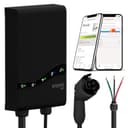
The answer to a panel that says no. The Pro ships with Emporia's Vue 3 energy monitor in the same box, watches what the rest of the house is drawing, and throttles the car in real time so the total never exceeds what the service can carry — which is how a 48-amp charger ends up on a panel that a load calculation says has no room for one. You pay roughly Home Flex money for it, and only the load management justifies that.

For the panel that said no
$599.00 · View on Amazon

Price as of September 18, 2026. #ad How we’re funded

3
Autel MaxiCharger 80A

Autel MaxiCharger 80A

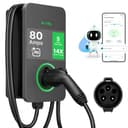
The ceiling of home AC charging: 19.2 kW on a 100-amp circuit, which is roughly double what a 48-amp charger does. Almost no car can actually take it — most cap their onboard charger somewhere between 7.7 and 11.5 kW — so buy this for a specific vehicle that accepts 80 amps, or for a future-proofed circuit you already have. Otherwise it is a very good, very expensive 48-amp charger.

For the car that can take 80 amps
$908.98 · View on Amazon

$1,069.0015% off

Price as of September 18, 2026. #ad How we’re funded

4
Autel MaxiCharger Home

Autel MaxiCharger Home

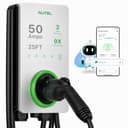
Built for the harshest driveway. The NEMA 4X enclosure is rated to keep charging in extreme cold and heat, it pushes a full 50 amps, and the app is capable. If your charger lives fully exposed to the weather, this is the one.

For the driveway that freezes
$499.00 · View on Amazon

$568.0012% off

Price as of September 18, 2026. #ad How we’re funded

The picks in full

#1For the household that just got a second EV

Grizzl-E Duo Connect 40A

One box, two cables, one circuit. The Duo Connect lets a two-EV household charge both cars overnight without a second charger, a second breaker or a panel upgrade — because it splits one 40-amp supply between the connectors rather than doubling it. That is the whole trade: convenience and a much cheaper install, at half the speed each when both cars are plugged in.

Strengths

  • Charges two EVs from one 40 A circuit — no second breaker, no panel upgrade
  • Grizzl-E's cast-aluminum, IP67-sealed body with two 25 ft cold-flexible cables
  • Per-connector current limits and scheduling in the Grizzl-E Connect app

Trade-offs

  • 40 A is the TOTAL, not per car — two cars charging at once get about 4.8 kW each
  • Costs roughly what two single chargers cost, so the saving is in the wiring, not the box
  • This Amazon SKU is NACS-to-NACS; a mixed-fleet household needs a different cable pairing
Max output
40 A
Power
9.6 kW
Connector
NACS
Install
NEMA 14-50 plug or hardwired
Cable length
25 ft
Warranty
Not published
WiFi + app
Yes
Certifications
UL tested and certified

Our charging-speed math. The 40 A / 9.6 kW rating is for the whole unit. One car alone gets the full 9.6 kW — about 34 miles of range per hour at ~3.5 mi/kWh. Two cars at once split it: roughly 4.8 kW, or about 17 miles per hour, each.

Build note. Two 25 ft output cables from a single cast-aluminum, IP67-sealed body rated -30C to +50C, with an LED per connector and a DIP-switch current selector (16/24/32/40 A). Grizzl-E states dual charging automatically splits the available current in half, or you can set each connector's current in the Grizzl-E Connect app.

Specs read from the manufacturer spec sheet, on August 12, 2026. “Not published” means the brand does not state that figure.

#2For the panel that said no

Emporia Pro

The answer to a panel that says no. The Pro ships with Emporia's Vue 3 energy monitor in the same box, watches what the rest of the house is drawing, and throttles the car in real time so the total never exceeds what the service can carry — which is how a 48-amp charger ends up on a panel that a load calculation says has no room for one. You pay roughly Home Flex money for it, and only the load management justifies that.

Strengths

  • PowerSmart throttles charging against real-time whole-home load, so a small service can host a big charger
  • 48 A hardwired or 40 A on a NEMA 14-50 plug — one unit covers both installs
  • UL listed, ENERGY STAR certified and NEMA 4 rated for indoor or outdoor, with a 25 ft cable

Trade-offs

  • PowerSmart depends on the bundled Vue 3 monitor being installed in your panel too — it is not a charger-only feature
  • Costs meaningfully more than Emporia's own Classic, which charges just as fast
  • 48 A still needs a 60-amp circuit; PowerSmart manages the load, it does not create capacity
Max output
48 A
Power
11.5 kW
Connector
J1772
Install
Hardwired or NEMA 14-50 plug
Cable length
25 ft
Warranty
3 years
WiFi + app
Yes
Certifications
UL listed, ENERGY STAR

Our charging-speed math. At 48A hardwired (11.5 kW by our arithmetic of 48 x 240 V) and ~3.5 miles per kWh it adds about 40 miles of range per hour; on a NEMA 14-50 plug it is capped at 40A, about 34 miles per hour. When PowerSmart is protecting the service it will deliberately deliver less than that at peak household load.

Build note. Ships bundled with Emporia's Vue 3 energy monitor, which reads the whole home's draw at the panel; the charger then raises or lowers its own current to keep total service load inside its limit. NEMA 4 body, 25 ft cable, and a J1772 or NACS cable option.

Specs read from the manufacturer spec sheet, on August 18, 2026. “Not published” means the brand does not state that figure.

#3For the car that can take 80 amps

Autel MaxiCharger 80A

The ceiling of home AC charging: 19.2 kW on a 100-amp circuit, which is roughly double what a 48-amp charger does. Almost no car can actually take it — most cap their onboard charger somewhere between 7.7 and 11.5 kW — so buy this for a specific vehicle that accepts 80 amps, or for a future-proofed circuit you already have. Otherwise it is a very good, very expensive 48-amp charger.

Strengths

  • 80 A / 19.2 kW — the fastest AC charging you can install at a house
  • Output adjustable from 6 A to 80 A in the app, so it can be dialed to any circuit
  • NEMA 3S / IK10 enclosure rated -40F to 131F, with UL and CSA listings and ENERGY STAR

Trade-offs

  • Needs a 100-amp circuit for full output — a service upgrade for most homes
  • Very few EVs accept more than 11.5 kW on AC, so the extra amps often go unused
  • Autel's own pages disagree on the warranty term (5 years on the body vs 3 extendable to 5)
Max output
80 A
Power
19.2 kW
Connector
J1772
Install
Hardwired
Cable length
25 ft
Warranty
5 years
WiFi + app
Yes
Certifications
UL 2594, UL 2231-1/2, UL 1998, CSA C22.2 No. 280, ENERGY STAR

Our charging-speed math. At its full 80A (19.2 kW) and ~3.5 miles per kWh it would add roughly 67 miles of range per hour — but only into a car that accepts 19.2 kW on AC. Dialed to 48A (11.5 kW) it is about 40 miles per hour, the same as any other 48-amp charger.

Build note. Hardwired 19.2 kW unit with a 25 ft cable; output is adjustable 6-80 A in the Autel Charge app and by DIP switch (16/24/32/40/48/50/64/72/80 A), in a NEMA 3S / IK10 enclosure rated -40F to 131F, with WiFi, Ethernet and RS485.

Specs read from the manufacturer spec sheet, on August 12, 2026. “Not published” means the brand does not state that figure.

#4For the driveway that freezes

Autel MaxiCharger Home

Built for the harshest driveway. The NEMA 4X enclosure is rated to keep charging in extreme cold and heat, it pushes a full 50 amps, and the app is capable. If your charger lives fully exposed to the weather, this is the one.

Strengths

  • NEMA 4X enclosure rated for very cold and hot conditions
  • Full 50A output with a 25 ft cable
  • WiFi, Bluetooth and a capable app

Trade-offs

  • 50A needs a 60A circuit and typically a hardwired install
  • App and ecosystem are newer than ChargePoint's
Max output
50 A
Power
12 kW
Connector
J1772
Install
Hardwired
Cable length
25 ft
Warranty
3 years
WiFi + app
Yes
Certifications
CSA certified, ENERGY STAR

Our charging-speed math. At its 50A max (12 kW) and ~3.5 miles per kWh it adds roughly 42 miles of range per hour.

Build note. NEMA 4X weatherproof enclosure rated for operation down to about -40 degrees F.

Specs read from the manufacturer spec sheet, on July 19, 2026. “Not published” means the brand does not state that figure.

Why most “upgrade” chargers would sit in a box

There are two chargers involved in charging any EV, and the box on the wall is the less important one. The real charger is inside the car — our onboard charger guideexplains it — and its rating is a hard ceiling. Most EVs accept somewhere between 7.7 and 11.5 kW on AC. A recipient with a 40-amp charger and a car capped at 7.7 kW gains nothing from a 48-amp unit, and nothing again from an 80-amp one. The same logic applies to apps: if their current charger’s app already does scheduling and energy tracking, a second one does the same thing in a different color.

So before buying any of the four below, confirm the problem exists. Each write-up starts with the question to ask.

The picks, and the question to ask first

Grizzl-E Duo Connect — for the household that just got a second EV. Ask: “Are you two fighting over the charger?” If yes, this is the gift. One box, two 25-foot cables, one circuit: the Duo Connect splits a single 40-amp supply between two cars rather than needing a second breaker or a panel upgrade, which is what makes a second EV affordable to charge. Both cars plugged in at once get about 4.8 kW each — roughly 17 miles of range an hour — and one car alone gets the full 9.6 kW. It is Grizzl-E’s cast-aluminum, IP67-sealed build, with per-connector limits and scheduling in the app. What to check: the SKU we link is NACS-to-NACS, so it suits two Teslas or NACS-port cars; a mixed household needs a different cable pairing. Read the Duo Connect review.

Emporia Pro — for the panel that said no.Ask: “Did the electrician make you get a smaller charger than you wanted?” The Pro ships with Emporia’s Vue 3 energy monitor in the box, watches the whole house’s draw in real time, and throttles the car so the total never exceeds what the service can carry — which is how a 48-amp charger ends up on a panel a load calculation said was full. UL listed, ENERGY STAR, NEMA 4 body, 25-foot cable, hardwired to 48 amps or 40 on a 14-50 plug. What to check: the monitor has to be fitted in their panel, so this is a gift plus an electrician visit, and it costs meaningfully more than the Emporia Classic that charges just as fast. Read the Emporia Pro review and our load management guide.

Autel MaxiCharger 80A — for the car that can take 80 amps. Ask: “What is your car’s maximum AC charging rate?” If the answer is above 11.5 kW — a few electric trucks and premium models — this is the ceiling of home charging: 19.2 kW on a 100-amp circuit, roughly double a 48-amp unit, in a NEMA 3S / IK10 body rated from -40°F to 131°F, with output adjustable from 6 to 80 amps. If the answer is 11.5 kW or less, it is a very good, very expensive 48-amp charger, and the 100-amp circuit it wants is a service upgrade for most homes. Autel’s own pages also disagree on the warranty term, which we note rather than resolve. Read the Autel 80A review and 48 vs 80 amps.

Autel MaxiCharger Home — for the driveway that freezes.Ask: “Does your cable go stiff in winter?” or simply notice where the car parks. The MaxiCharger Home’s NEMA 4X enclosure is the only corrosion-rated body in our lineup, published for operation down to about -40°F, with a full 50 amps, a 25-foot cable and a capable app. It is the unit both our cold-weather and outdoor roundups rank first. What to check: it hardwires on a 60-amp circuit, so it replaces rather than supplements what is there. Read the MaxiCharger Home review.

What to give instead, if none of the four applies

If they have one car, a charger that fits, room on the panel and a garage, the honest answer is that they do not need charging hardware from you. Two things still land. The first is the install itself for anyone who has been meaning to move from a plug-in unit to a hardwired 48-amp circuit; our installation cost guide gives the realistic number. The second is a portable charger for the trunk, which a wall-charger owner rarely buys for themselves and which turns any 240-volt outlet on a trip into a full-speed charge — the Ampure Go in our renter gift guide is the one to look at, because it also takes a household socket. Keep whichever box sealed until the question above is answered, so the return stays easy.
Frequently asked questions

Is a faster charger a good upgrade gift?

Usually not. A 40-amp charger adds roughly 34 miles of range an hour and a 48-amp one about 40, and either fills most cars overnight. More importantly, the car's onboard charger sets a hard ceiling — most EVs cannot take more than 11.5 kW on AC no matter what is on the wall. Buy a faster charger only for a specific car that can use it, which is the Autel 80A case on this page.

What should I check before buying a dual-port charger for a two-EV household?

Two things. First, that they actually charge both cars at home on the same nights — many two-EV households manage fine by moving one plug. Second, the connectors: the Grizzl-E Duo Connect SKU we link is NACS-to-NACS, so it suits two Teslas or NACS-port cars; a household with one J1772 car and one NACS car needs a different cable pairing. Also understand that its 40 amps is the total, split between the cars when both are charging.

What does load management actually do?

It lets a bigger charger live on a panel that a load calculation says has no room for it. The Emporia Pro watches what the rest of the house is drawing through a bundled energy monitor and throttles the car in real time so the total never exceeds what the service can carry. The recipient still needs a 60-amp circuit for the charger itself; what they avoid is the service upgrade. The catch: the monitor has to be installed in their panel too, which is electrician work.

Who can actually use an 80-amp charger?

Very few drivers today. Most EVs cap their onboard charger between 7.7 and 11.5 kW, so an 80-amp, 19.2 kW charger runs at whatever the car allows. A handful of vehicles — some full-size electric trucks and premium models — accept more. Unless you know the recipient's car is one of them, or they have a 100-amp circuit already run for a future car, the Autel 80A is an expensive 48-amp charger. Ask before buying.

Will these need an electrician?

All four are hardwired installs or, in the Duo Connect's case, sold either way, and each replaces an existing charger on the wall — so yes, expect a licensed electrician, usually a permit, and in the Autel 80A's case very likely a service upgrade for a 100-amp circuit. Our installation guides cover what each involves. The realistic gift is the charger plus the conversation about the install.

What if it is the wrong one?

Keep it sealed until the recipient has confirmed the problem it solves applies to them. In 2025 Amazon's extended holiday window allowed most items bought between November 1 and December 31 to be returned until January 31; the dates are announced each year, so confirm the current policy at purchase.

Sources

  • NFPA — Using the Latest NEC for EV Charger InstallationsNFPA on NEC (NFPA 70) Article 625: EV charging is a continuous load, so circuits are sized to 125% of load (the 80% rule) (accessed July 19, 2026)
  • U.S. DOE Alternative Fuels Data Center — Electric Vehicle Charging StationsUS DOE on charging levels: Level 1 (~1.9 kW, ~5 mi/hr), Level 2 (2.9-19.2 kW, ~7.2 kW typical residential, ~25 mi/hr), and DC fast charging (accessed July 19, 2026)
  • United Chargers — Grizzl-E Duo Connect 40A technical specificationsGrizzl-E's own spec table for the Duo Connect 40A: two output cables, Type 1 (J1772) and NACS Level 2 connections, aluminum enclosure, operating temperature -30C to +50C, IP67 protection, 25 ft output cable length, 18 in input cable, 208-240 VAC, nominal input current 16/24/32/40 A, maximum output current 40 A, one LED indicator per connector, DIP-switch power selector, 40 lb unit weight (accessed August 12, 2026)
  • United Chargers — Grizzl-E Duo Connect 40A product overviewGrizzl-E's own overview for the Duo Connect 40A: a dual-port Wi-Fi connected 40A plug-in charger whose dual charging 'automatically splits the available current in half, or you can set individual charging currents for each connector with the Grizzl-E Connect app', with scheduling, usage history, remote lockout, monitoring and diagnostics in the app (accessed August 12, 2026)
  • Emporia Energy — Pro EV Charger product pageEmporia's own listing for the Pro: up to 48 A hardwired on a 60-amp circuit or up to 40 A on a NEMA 14-50 outlet, 25 ft cable, NEMA 4 rated for indoor or outdoor, UL listed and ENERGY STAR certified, 3-year warranty, and PowerSmart load management that requires the bundled Vue 3 energy monitor (accessed August 18, 2026)
  • Autel Energy — MaxiCharger 80A 19.2kW Residential EV Charger (US store listing)Autel's own US listing: 19.2 kW (240V AC 80A), 208/240V AC 50/60 Hz, SAE J1772, hardwired, 25 ft (7.5 m) cable, output adjustable from 6A to 80A in the app and 16/24/32/40/48/50/64/72/80 A by DIP switch, UL 2594, UL 2231-1, UL 2231-2, UL 1998, CSA C22.2 No. 280, FCC Part 15 Class B, ENERGY STAR, OpenADR 2.0b, NEC Article 625, Wi-Fi / Ethernet / RS485 with the Autel Charge app and cloud, and a warranty of 5 years on the charger body, backplate and internal components with 1 year on the display screen, charging cable and connector (accessed August 12, 2026)
  • Autel Energy — MaxiCharger AC 80A product pageAutel's own product page for the MaxiCharger AC 80A: NEMA 3S / IK10 enclosure, operating temperature -40F to 131F (-40C to +55C) with derating above 113F, 19 ft or 25 ft cable options, SAE J1772 or NACS connector, hardwired with wall or pedestal mounting, output adjustable 6A to 80A via the mobile app, and a stated warranty of 3 years extendable up to 5 — a figure that differs from the 5-year term on Autel's own US store listing for the same unit (accessed August 12, 2026)
  • Autel Energy — MaxiCharger AC Elite Home 50A product pageAutel's own listing: compliant with NEMA 4X standards, operating temperature -40F to 131F, 25 ft cable, 3-year warranty (accessed July 20, 2026)
  • FuelEconomy.gov — Fuel Economy in Cold Weather (U.S. DOE / EPA)DOE/EPA on cold weather: EV range can drop about 41% in mixed driving at 20F versus 75F with the cabin heater running (about 12% with the heater off), roughly two-thirds of the extra energy goes to heating the cabin, and preheating while still plugged in extends range (accessed July 20, 2026)
  • About Amazon - Amazon's holiday return policy 2025: what to knowAmazon's own statement of its 2025 extended holiday window: 'most items purchased between November 1 and December 31 can be returned until January 31, 2026' (Apple-branded products through January 15). The window is announced each year, so confirm the current year's dates on Amazon before relying on it for a gift (accessed September 13, 2026)

Keep reading